- agentic-ai
- programming
- claude code
The Contractor Paradox: Does Programmer Intelligence Still Matter?

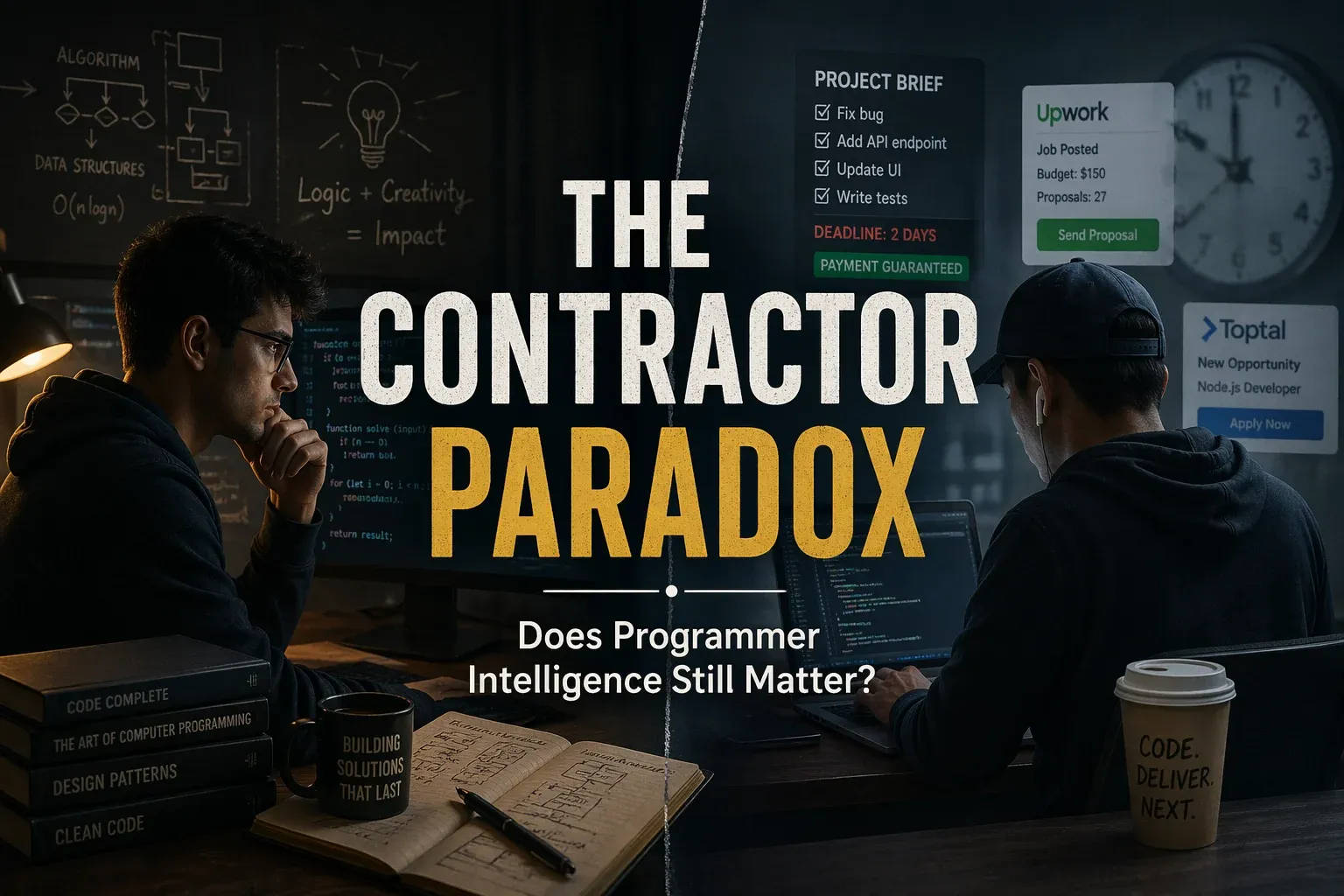
As AI absorbs the act of writing code, the real question is not whether machines can build the house — it is whether anyone still knows how to inspect the walls.
Every major transition in programming history has been sold as an elevation in abstraction. From punch cards to assembly, from assembly to C, from C to Python — each step moved the programmer further from the machine and closer to the problem. The argument held beautifully: by hiding the hardware, we freed human minds to think at higher levels. More expressive languages meant better software, faster, from more people.
The shift to AI-assisted coding is being framed in exactly the same way. But it is not the same thing. And confusing the two may be one of the most consequential misreadings of the moment we are living through.
Why this shift is different
When we moved from low-level to high-level languages, we were still operating within a system of formal rules. A Python function, a SQL query, a shell script — these are precise. They mean exactly what they say. The abstraction was syntactic sugar over the same underlying determinism. You still had to think like a machine, just with better vocabulary.
Working with an AI model is not that. You are not writing instructions for a deterministic system. You are communicating intent to a statistical network that infers what you probably want, based on patterns in the vast literature of human expression and prior code. There is no formal grammar, no compiler, no spec sheet. The input medium is natural language — which is, by its very nature, ambiguous, contextual, and unverifiable.
“The distance between what you asked for and what was built has never been harder to measure and never mattered more.”
This is genuinely new terrain. And it changes what intelligence means in the context of software.
The house you cannot inspect
Analogy
Imagine hiring a contractor to build your house. You describe the rooms, the windows, the feel you want. The contractor builds it. You move in. The house looks exactly right. But you never see the blueprints. You do not know whether the ceiling is weatherproofed, whether the load-bearing walls are correctly placed, whether the electrical routing is safe. The house looks beautiful — until the first heavy rain, or the first earthquake. Someone who has built houses themselves knows which questions to ask before signing off. Someone who has only ever hired contractors does not know what they do not know.
This is the precise situation with AI-generated code today. The outputs are fluent. They are often correct. They pass superficial inspection. But the programmer who has never written code — who has only ever prompted and accepted — lacks the internal model required to probe what was actually produced. They cannot ask whether the API calls are rate-limited safely, whether the database queries will degrade at scale, whether the authentication logic has a subtle flaw that only surfaces under specific conditions.
Intelligence, in this context, is not about the ability to type syntax. It is about the ability to reason about systems: to hold a mental model of what is happening beneath the abstraction, and to know when that model is being violated.
The compounding problem
What makes this particularly sharp is the feedback loop that follows. Contractors learn from the houses they build. AI models are trained — directly or indirectly — on the code that gets written, deployed, and validated in the world. If the people reviewing and deploying that code increasingly lack the technical depth to identify subtle failures, then flawed patterns get reinforced. The model learns that this kind of authentication logic is acceptable, because no one caught the flaw. The ceiling without weatherproofing becomes a training example of how ceilings are built.
This is not a hypothetical. It is already happening. AI systems generate code that gets pushed to production, reviewed by developers who are themselves using AI to review code. The verification layer that catches structural errors is thinning, precisely as the surface area of AI-generated code expands.
The optimist’s bet — and its limits
The standard counter-argument runs like this: the models will improve. Future AI will understand requirements well enough to handle edge cases, security implications, and architectural tradeoffs without being explicitly prompted. The contractor will become so skilled that even vague briefs produce structurally sound buildings. You will not need to understand construction to get a safe house.
This bet is not unreasonable. Models have improved dramatically, and there is no obvious ceiling in sight. But it carries a hidden assumption: that the model can fully substitute for the client’s judgment. That a sufficiently capable AI can know what you want better than you can articulate it, and produce something you can trust completely without inspection.
“The hope is that the contractor gets good enough to handle vague requirements. But the current contractors are already building houses that owners are putting on display — and the reviewers have never laid a brick.”
We are nowhere near that point. And even if we reach it in narrow domains, the principle does not generalise. Security requirements depend on threat models that require domain knowledge to specify. Performance requirements depend on usage patterns that require systems thinking to anticipate. Business logic depends on organisational context that no model can fully infer from a prompt.
What intelligence means now
Programmer intelligence in the age of AI is not primarily about writing code. It is about three things that AI cannot yet reliably supply on your behalf.
The first is problem formulation. The hardest part of software is rarely the implementation — it is understanding what problem you are actually solving, and what properties the solution must have. This requires conceptual clarity that comes from having built systems, encountered their failure modes, and developed intuitions about what breaks and why.
The second is verification. The ability to look at a produced output — whether written by a human or a model — and assess whether it is actually correct, secure, and maintainable. This requires an internal model of how the system works, which can only come from having worked within systems directly.
The third is taste. Knowing when a solution is brittle, when an architecture will become a burden, when the short path now creates a long problem later. Taste is experiential. It is compressed from thousands of hours of building, debugging, and maintaining. It cannot be prompted into existence.
The generation entering now
What is genuinely new is the generation of practitioners who are beginning their relationship with software through AI entirely. They have never had to hold a program in their heads. They have never had to reason through a bug without a tool that offers plausible fixes on demand. They are building products — real ones, deployed ones — without having developed the internal models that let you interrogate what is actually running.
This is not a moral failure on their part. It is a rational response to available tools. But it produces a different kind of practitioner: one who is fluent in directing AI, but less equipped to detect when the direction went wrong.
The risk is not that these practitioners build nothing. They will build quite a lot. The risk is that they will not know what they have built — and neither will the models helping them build it.
The argument worth making
Programming languages were always a poor proxy for programmer intelligence. The ability to write syntactically correct code was necessary but never sufficient. What mattered was the thinking behind the code: the clarity of the mental model, the rigour of the reasoning, the judgment about tradeoffs.
AI has now removed the syntactic necessity almost entirely. What remains — the mental model, the rigour, the judgment — matters more than it ever did, not less. Because the gap between intent and output, always present, is now invisible in a new way. You cannot read the implementation and catch the error. You have to know enough about the problem to know what to check for, and to know that checking is necessary at all.
The house gets built either way. The question is whether anyone can tell, before the rain, that the ceiling was never weatherproofed.