- cryptography
- web-security
- software-architecture
Model Cards & Datasheets: The Missing Step Before Using your AI Tool

Stop Settling for “Good Enough”: Why You Aren’t Getting Peak Performance from Your AI
The Bike Analogy: The Temptation to Skip the Manual
I recently had a bit of a wake-up call. It started with my new motorcycle. Unlike most people, I actually sat down and read the owner’s manual. It turns out, the Engine kill switch that little red button everyone uses to turn off their bike is for emergencies only. By using it daily, it is slowly damaging the machines, all because they are trusted common practice over the actual instructions.
It hit me: We are doing the exact same thing with Artificial Intelligence. We treat complex, high-performance AI systems with less care and documentation review than we treat our vehicles.
We treat these incredibly complex, high-performance systems with less care than we treat a microwave. We see a text box, we type a prompt, and we assume the AI knows best. But we’re skipping the most important part: the manual (technically called the Model Card).
We see a new AI tool, we click ‘Use,’ and we assume the defaults are optimal. We let convenience and false confidence guide us. But just like that kill switch, skipping the official guide (Model Card, System Card, or AI Datasheet) prevents us from achieving the best, most reliable, and safest performance possible.
The question isn’t whether these documents are important for Responsible AI or not. The real question is: Why do we skip them, and what is the cost to our productivity and reliability?
![][image1]
Fig:1 (Alt Text: Two images comparing a bike kill switch warning with an AI system out of scope use warning, representing how ignoring either leads to damage or failure.)
The Manuals You Are Ignoring (And Why It Matters)
Just like a product needs a product manual, an AI system relies on two key documents for their transparency:
- The Model/System Card: The operating instructions. It details Intended Use, performance metrics, and AI model limitations.
- The Datasheet for Datasets: The ingredients label. It details how the data was collected, its composition, and potential biases.
Real-World Reality Check
To understand why reading the manual matters, let’s look into the three giants of the industry: ChatGPT, Gemini, and Grok.
To the casual user, they look identical to a simple chat box. But if you read their System Cards, you realize they are different vehicles entirely, built for different terrains.
-
ChatGPT (OpenAI): The documentation highlights an optimization for helpfulness and safety compliance. Its “manual” warns that it is fine-tuned to refuse certain harmful requests, which makes it excellent for corporate drafting but potentially restrictive for creative, edgy writing.
-
Gemini (Google): Its reports emphasize multimodal reasoning (video/images) and grounding in factual information. However, its safety guidelines are tuned specifically to avoid stereotyping, which requires understanding its specific bias mitigations to get the best results without over-correction.
-
Grok (xAI): In contrast, Grok’s documentation notes a “rebellious streak” and real-time access to X (Twitter) data. Its intended use is distinct: it tolerates “spicy” or sarcastic queries that ChatGPT might refuse.
The Risk: If you use Grok for a sensitive corporate HR policy document, or ChatGPT for uncensored real-time news commentary, you are ignoring their intended uses. You are taking a dirt bike to a Formula 1 track. The tool isn’t a failure, you just failed to read what it was built for.
The “Lazy Prompt” Trap
Because we view AI as a “black box” that knows everything, we tend to be lazy. We type things like: “Write me a mail” Then, we get a generic, boring answer and blame the AI.
If you understood the mechanics, the way the manual explains the model’s need for patterns, you would know that an AI without context is just guessing. To get peak performance, you have to stop asking naked questions.
Instead, effective prompt engineering usually involves combining four key elements:
- Context (Who/Why): Setting the stage.
- Example: “Act as a resident of a small town in the US.”
- Instruction (What): The specific task you want done.
- Example: ” Write a formal email to the Head of the City Council.”
- Input Data (The Source): The information the AI needs to process.
- Example: ” There needs to be 3 waste bins everywhere each for Dry waste, Wet Waste and Electrical Waste.”
- Output Indicator (The Format): How you want the answer to look.
- Example: “Frame this as a professional email with a compelling Subject Line. Use bullet points to list the pros, so it is easy for a busy official to scan.”
The Three Barriers That Sabotage Your AI Performance
We know these differences exist, yet we ignore them. The reasons are rooted in human nature, but overcoming them is the only way to unlock true AI performance.
1. The “Click and Go” Mentality
Modern AI tools are designed to be seamless. This elegance, however, masks the complexity of the underlying model.
- The Trap: Users treat a complex AI model like a simple app. We assume that if the output looks good, the system is flawless.
2. Perceived Time Cost vs. Real-Time Risk
Reading a Model Card or AI Datasheet takes time. In a rush to deployment, the pressure of speed often outweighs the risk of failure.
- The Trap: “I don’t have time to review 20 pages of Model Cards.”
- The Reality: The time saved by skipping the documentation is instantly dwarfed by the cost of a single AI-driven mistake: a data leak, a biased decision, or a system crash.
3. The Black Box Wish (The Desire for Magic)
Many people prefer to view AI as a magical “black box” that solves problems flawlessly.
- The Trap: We don’t want to read about the model’s failure modes because we want to believe it is infallible. We prioritize hype over the reality required for responsible AI.
![][image2]
Fig: 2 (Alt Text: Flow diagram showing a sequence from “New AI Tool” to “Illusion of Simplicity” to “Skip Manual” to “Sub Optimal Performance/High Risk.”)
The Cost of Ignorance: AI Performance Degradation
When you skip the Model Card and the AI Datasheet, you are actively deploying the AI in a sub-optimal state.
- Sub-Optimal Deployment: If the Model Card specifies a specific input format, but you use another, you guarantee AI performance degradation. You are forcing the machine to run inefficiently.
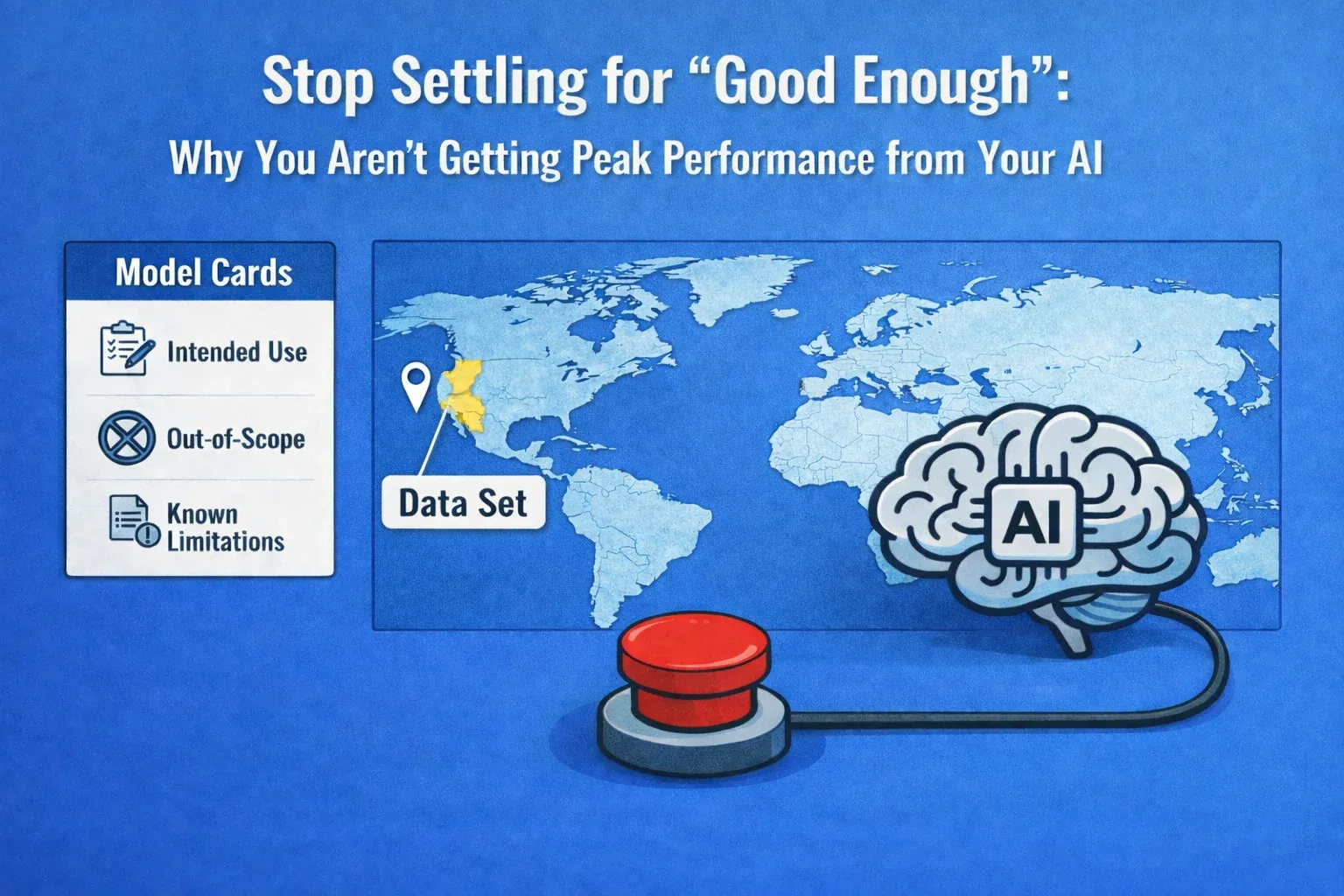
- Uncontrolled Bias: If the Datasheet shows data imbalance (e.g., 90% of data from one region), and you deploy globally, you risk encountering AI Bias. Your results will be unreliable for a huge portion of your users.
- Risk of Catastrophe: Ignoring an “Out-of-Scope” warning is like driving your street bike off-road. It leads to operational failures that halt productivity and create heavy cleanup efforts.
Your 3-Step Strategy: How to Read Model Cards and Unlock Performance
Achieving peak performance isn’t about theoretical power; it’s about reliable, safe, and controlled execution.
1. The 5-Minute Rule: Focus on the Warning Labels
You don’t need to be a statistician. Force yourself to find these three sections in every Model Card:
- Intended Use (What it must do)
- Out-of-Scope Uses (What it must not do)
- Known Limitations/Biases (Where it will likely fail)
2. Translate Risk into Cost
Stop thinking of bias as just an ethical issue, treat it as a business risk. If the Model Card shows an 80% accuracy rate for a specific subgroup, ask: “What is the financial cost of a 20% failure rate for our company?” This reframes the document as a necessity for AI governance.
3. Demand Documentation as a Standard
Make Model Cards and AI Datasheets mandatory for procurement. If a vendor can’t provide them, treat it as a significant red flag. This sends a clear message that transparency is non-negotiable for serious users.
Conclusion: Stop Trusting the Hype
We get frustrated when the AI refuses a prompt, hallucinates, or gives us boring answers, not realizing we are asking it to do something it was explicitly designed not to do.
This blog isn’t about becoming a data scientist. It’s about breaking the “black box” mentality. It’s about taking five minutes to read the “warning labels” so you can stop settling for “good enough” output and start getting the high-performance results these tools are actually capable of.
Stop trusting the magic. Read the manual.