Blockchain's Journey from Utopian Hype to Pragmatic Infrastructure

blockchain
web3
defi
crypto
decentralized
author avatar
Dev Sharma Senior Software Engineer @ Infocusp
28 min read  .  20 February 2026

image

The Great Filtering: Blockchain’s Journey from Utopian Hype to Pragmatic Infrastructure
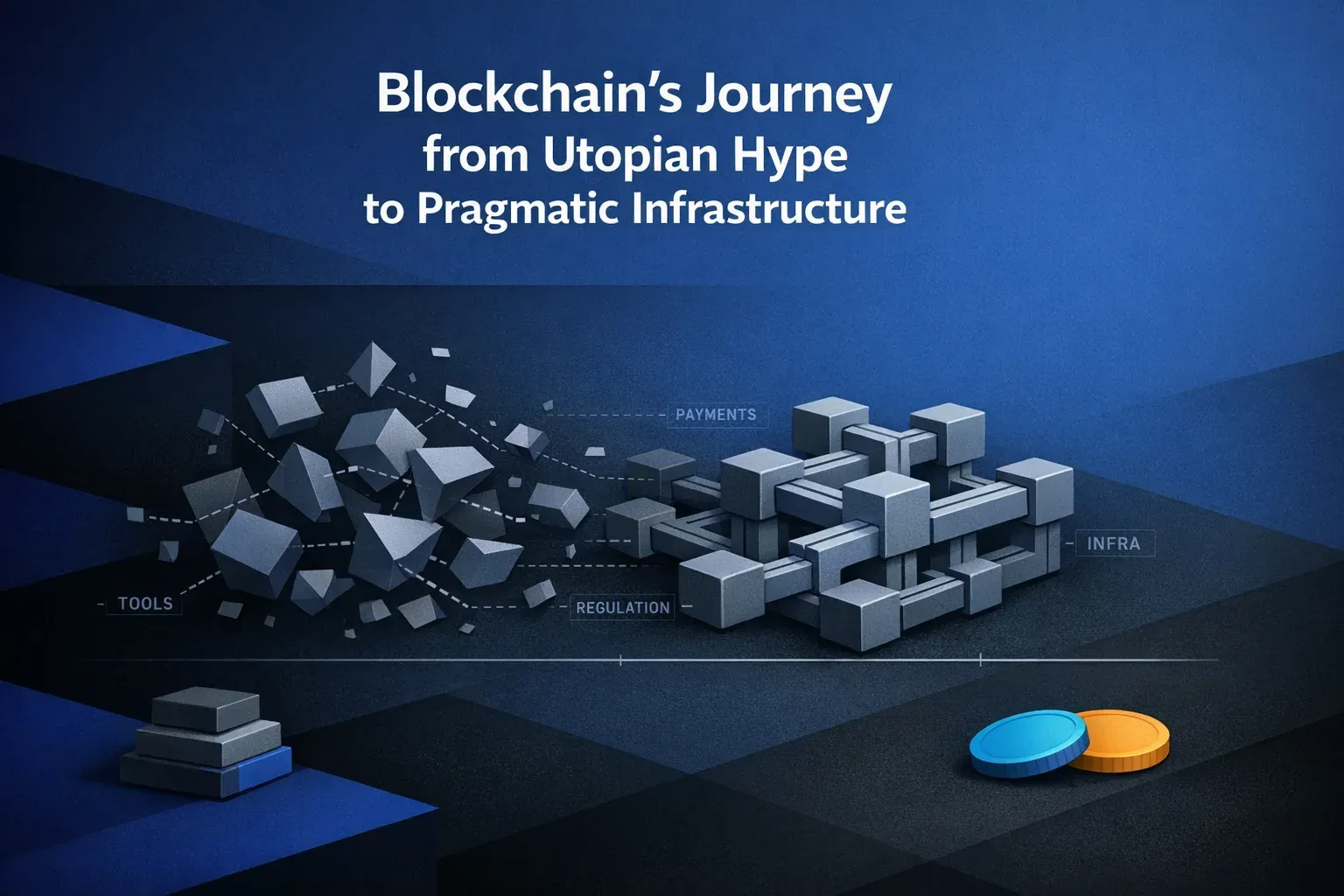
The initial fanfare surrounding blockchain technology promised a radical reconfiguration of digital interaction, a paradigm shift where decentralized trust, disintermediation, and tokenization would fundamentally reshape industries from finance to governance. This vision, characterized by its expansive ambition, foresaw a world where code superseded institutional authority, and digital ownership became an inalienable right. However, as the technology has matured, a significant recalibration of expectations has occurred. Many of the most loudly touted applications have failed to materialize or have experienced dramatic contractions, revealing a chasm between early idealism and practical viability. This report synthesizes insights from a range of recent industry analyses and research to trace this evolution, arguing that blockchain is not in a state of failure, but rather undergoing a critical process of "correction" or "compression." The initial, broad-based hype is giving way to a more focused, pragmatic, and ultimately more sustainable phase of development, where the emphasis is shifting from grandiose, ecosystem-wide transformations to specific, value-driven applications that can justify their inherent complexity. This transition involves a discerning "filtering" process, where unsustainable models are being abandoned, and foundational, infrastructure-focused projects are demonstrating enduring value. The most interesting phase of a technology often begins after the hype leaves, as it is freed from the burden of unrealistic expectations and can begin to build genuine, lasting utility. This report will explore this "great filtering," examining the sunset of once-prominent tools and narratives, the persistent challenges in sectors like gaming and social media, and the quiet, yet significant, successes emerging in areas such as stablecoins and tokenization, all within the context of an evolving regulatory landscape. This journey from utopian hype to pragmatic infrastructure reveals a technology ecosystem that is, in essence, growing up, prioritizing substance over spectacle, and laying the groundwork for its next, more mature, chapter of development.

The Sunset of Early Abstractions and Ideals: A Pragmatic Reassessment of Blockchain's Promise

The trajectory of blockchain technology's adoption and development has been marked by a pronounced shift from its initial, expansive promises to a more grounded and pragmatic reality. This transition is characterized by what can be termed a "sunset" of early abstractions and ideals, where tools, concepts, and platforms that once defined the ecosystem are being re-evaluated, deprioritized, or altogether abandoned. This is not necessarily an indication of wholesale failure, but rather a natural, if sometimes jarring, process of ecosystem maturation and Darwinism, where the most viable and useful elements persist while those that fail to deliver proportional value or adapt to evolving needs are left behind. A prime example of this phenomenon is the September 2023 announcement by ConsenSys regarding the sunsetting of Truffle and Ganache [0]. For a considerable period, these tools formed the bedrock of Ethereum smart contract development. Truffle provided a comprehensive development environment, streamlining the processes of compiling, testing, and deploying Solidity contracts, while Ganache offered developers a personal, local Ethereum blockchain, enabling rapid iteration and experimentation without incurring real gas costs. Their foundational status in the early developer ecosystem is undeniable. However, the official explanation for their deprecation cited resource prioritization, with ConsenSys choosing to focus its efforts on other strategic products like MetaMask, its SDK ecosystem, and infrastructure offerings such as Infura and Linea [0]. While this is the stated reason, a deeper, more fundamental cause was widely recognized by developers: the ecosystem had, in many respects, outgrown these pioneering tools. Newer development environments like Hardhat and Foundry had gained significant traction by offering features that better aligned with the increasing complexity and sophistication of smart contract development. These modern frameworks boasted faster compilation times, more robust debugging capabilities, and a design philosophy that prioritized TypeScript and Rust, reflecting broader trends in software engineering. Their testing frameworks were also perceived as being better suited to handling the real-world complexities that dApps were beginning to encounter. By the time ConsenSys officially sunset Truffle and Ganache, a significant portion of serious development teams had already migrated to these newer alternatives. This transition was not merely an abandonment of old tools, but a clear instance of ecosystem Darwinism, analogous to how jQuery gave way to React in frontend web development, Hadoop was largely superseded by Spark in big data processing, and Virtual Machines (VMs) saw their dominance challenged by Kubernetes in container orchestration. The blockchain tooling space was maturing, and with that maturation came a natural progression towards more powerful, efficient, and developer-friendly abstractions, leaving earlier, less versatile tools behind. This evolution underscores a critical aspect of technological progress: what is foundational at one stage can become obsolete at the next, as the collective understanding of the technology's requirements and potential deepens.

This pattern of quiet retrenchment and pragmatic reassessment extended beyond developer tooling into areas that had once championed decentralization with considerable ideological fervor. A notable instance is Brave browser's decision in early 2023 to remove native IPFS (InterPlanetary File System) support from its browser [4]. For a period, Brave had positioned itself as a Web3-friendly alternative, integrating native ipfs:// URL support and offering users built-in IPFS node options. This move was widely seen as symbolic, a validation by a mainstream browser that decentralized web infrastructure was poised for broader adoption. The removal of this native support, therefore, sent a subtle but significant message. Brave cited several reasons for this decision, including low real-world usage among its general user base, the high maintenance cost associated with supporting the feature, persistent security and user experience (UX) concerns, and inconsistent performance across different platforms [4]. The decision, according to Brave, ultimately came down to pragmatism over ideology. The core takeaway is that "decentralization is not free—someone always pays the operational and UX cost" [4]. While Brave did not entirely abandon IPFS—users can still access IPFS content through public gateways, browser extensions, or external clients—the default, most accessible user experience, which is crucial for mainstream adoption, reverted to simpler, more centralized paths. This action highlights a fundamental challenge for decentralized technologies: if they cannot justify their inherent complexity and potential performance overhead with clear, tangible benefits for the average user, they will struggle to secure a place at the core of mainstream products. The expectation that users would readily embrace a more complex browsing experience for the abstract principle of decentralization proved, in this case, to be misplaced. This retreat suggests that for decentralized web infrastructure to achieve widespread adoption, it must offer a user experience that is at least on par with, if not superior to, existing centralized solutions, or provide a compelling, immediately obvious advantage that outweighs any additional friction. The Brave IPFS case serves as a cautionary tale against assuming that technical superiority or ideological purity will automatically translate into user acceptance. It underscores the critical importance of user-centric design and the need for decentralized systems to seamlessly integrate into existing user workflows if they are to move beyond niche applications.

The broader context for these specific instances of tool and feature sunsetting is a general decline in the initial, all-encompassing hype that once surrounded blockchain technology. As noted by CIO magazine, "The blockchain hype starting in the late 2010s has nearly died, replaced by intense interest in AI and hurt by sketchy cryptocurrency and NFT schemes" [6]. This shift in sentiment is partly due to the very real and damaging impact of fraudulent activities and unsustainable economic models that proliferated during the boom years, which tarnished the reputation of the broader technology. However, it also reflects a growing understanding of blockchain's actual capabilities and limitations. Gartner, in its "Blockchain-Based Transformation: A Gartner Trend Insight Report," aimed to help enterprise architecture (EA) and technology innovation leaders, Chief Information Officers (CIOs), and technology and service providers (TSPs) understand what has changed and to assess the current market state as the blockchain landscape matures [0]. This focus on maturation and understanding the changed landscape is a key indicator of the ecosystem's transition from hype to a more sober evaluation. Gartner also forecasted that the business value generated by blockchain would grow rapidly, reaching 3.1 trillion by 2030, suggesting that despite the fading of initial hype, significant long-term potential remains, albeit likely in more specific, targeted applications rather than as a universal panacea [3]. The "Digital Disruption Profile: Blockchain's Radical Promise Spans Business and Society" report further elaborates on this potential, emphasizing that blockchain offers a radical change in computing and business paradigms, while also acknowledging that its impact on industries is not uniform and that the technology itself is still a work in progress, albeit with rampant research and development [0]. This nuanced perspective acknowledges both the transformative potential and the ongoing evolutionary nature of the technology. The initial phase of blockchain's development was characterized by a broad, almost limitless, sense of possibility. Its second decade, as the blog astutely observes, is increasingly about restraint and the justification of its existence through tangible value. The sunsetting of tools like Truffle, the scaling back of features like Brave's IPFS support, and the general waning of the initial, often unrealistic, hype all point to a fundamental truth: technologies that demand significant sacrifice—in terms of usability, development effort, or operational cost—without delivering proportional, demonstrable value, do not scale. The ecosystem today is arguably smaller in terms of its grandiose ambitions, quieter in its pronouncements, and far more grounded in practical realities. This is not a sign of failure, but rather a necessary and healthy process of maturation—a process of "growing up" that separates the enduring from the ephemeral. The focus is shifting from what blockchain could theoretically do to what it can reliably and efficiently do, marking a crucial step in its evolution from a speculative concept to a functional piece of the global technological infrastructure. This filtering process, while sometimes appearing as a retreat or a loss of momentum, is essential for clearing the way for the development of truly sustainable and impactful blockchain-based solutions.

The Unraveling of Grandiose Visions: Gaming, Social, and the Perils of Token-Centricity

The initial wave of blockchain enthusiasm was propelled by a series of grandiose visions that promised to revolutionize entire sectors of the digital economy. Among the most prominent were the ideas of blockchain gaming and Web3 social networks, both of which, despite attracting significant investment and attention, have largely failed to deliver on their early, transformative promises. Their struggles offer critical insights into the pitfalls of prioritizing tokenomics and ideological purity over user experience, genuine utility, and sustainable economic models. The narrative of blockchain gaming, in particular, burned brightly before experiencing a dramatic and widely documented collapse. Between 2017 and 2021, the promise was intoxicating: players could earn real money through gameplay, truly own their in-game assets as non-fungible tokens (NFTs), and participate in novel digital economies. Games like CryptoKitties, Axie Infinity, The Sandbox, and Decentraland became emblematic of this movement, dominating headlines and attracting millions of users and investors. At its zenith, Axie Infinity transcended being merely a game; for many, particularly during the pandemic, it evolved into a primary source of income, creating a "play-to-earn" phenomenon that seemed to herald a new paradigm for both gaming and work. However, this model proved to be fundamentally unsustainable. Reality arrived with a thud, as several critical flaws became apparent. Firstly, scalability issues severely hampered the user experience. Blockchain networks, especially those supporting popular games, struggled to handle the transaction throughput required for real-time gaming, leading to exorbitant gas fees, stalled transactions, and gameplay that often slowed to an unacceptable crawl. The fundamental principle that "every click costs money" proved to be a major barrier to creating engaging gaming experiences [21]. Secondly, and perhaps more critically, many of these games were simply not fun. The focus had overwhelmingly shifted towards optimizing tokenomics and facilitating speculation, rather than developing compelling gameplay mechanics and engaging narratives. Players were often drawn by the prospect of profit rather than the enjoyment of the game itself, leading to an engagement that was inherently fragile and dependent on continuous financial incentives. This was directly tied to the third major failure: the play-to-earn model was, in many cases, structurally unsustainable. It relied on a constant inflow of new players and capital to support the earnings of existing participants, creating a pyramid-like dynamic. Once growth inevitably slowed, the in-game economies collapsed, often catastrophically. Axie Infinity's native token, for example, lost over 95% of its value from its peak, devastating those who had come to rely on it for income [21]. The assertion that "Play-to-earn didn’t fail because of bad execution. It failed because it was economically impossible" captures this fundamental flaw [21]. Beyond economic and gameplay issues, the user experience (UX) associated with blockchain gaming alienated traditional gamers. The complexities of managing wallets, safeguarding private keys, understanding gas fees, and navigating token swaps created significant friction that mainstream gamers, accustomed to seamless onboarding and intuitive interfaces, were unwilling to endure. Finally, an increasingly hostile regulatory and public optics environment, with questions arising around gambling, securities, and consumer protection, further scared away developers and capital, contributing to the sector's decline.

The numerical evidence of this collapse is stark. Investment in blockchain gaming plummeted by 72% in 2023, falling to just $1.4 billion [22]. This drying up of funding was accompanied by a significant number of project discontinuations, with 410 blockchain games reported to have shut down in 2023 [21]. The downturn continued into 2025, with Q1 gaming VC funding falling by a staggering 71% quarter-over-quarter, even as the deal count paradoxically rose by 35%, suggesting smaller, more cautious investments [23]. Even surviving games struggled to maintain user engagement once speculative incentives were removed. For instance, the game Pixels saw its daily user count drop from one million to 250,000 after bot-driven rewards were removed, illustrating how much of the apparent "growth" was driven by non-organic, incentive-based activity rather than genuine user interest [21]. The fundamental lesson from this era is that "Games succeed because they’re good games—not because they’re financial products" [21]. The Blockchain Game Alliance's (BGA) 2025 State of the Industry Report reflects this hard-learned wisdom. It indicates that the blockchain gaming sector is entering a new phase of maturation, moving "beyond its speculative origins toward a more operationally disciplined, product-led future" [20]. The report highlights a shift in priorities among developers, with 64.4% of respondents citing high-quality game launches as the primary driver for future industry success, and 29.5% pointing to sustainable, revenue-driven business models as a key growth factor [20]. This marks a significant departure from the earlier token-sale-first approach, signaling a move towards leaner, product-first strategies supported by diverse monetization streams. The report also notes that stablecoins are playing an increasingly important role in this shift, offering improved settlement efficiency and reduced cross-border friction, which could support real-world commerce at scale within gaming ecosystems [20]. While challenges remain, including scams (cited by 38.9% as the greatest threat to industry credibility) and lack of funding (36.0% reported this as their company’s biggest operational challenge) [20], the overall sentiment is one of an industry evolving towards greater discipline and long-term viability, focusing on core gaming principles rather than purely financial speculation.

Similar to gaming, the vision for Web3 social networks also failed to gain mainstream traction, despite the compelling promise of user-owned identity, censorship resistance, and portable social graphs. Projects like Steemit, Lens Protocol, and Farcaster attracted developer interest and investment but struggled to break through to a broader audience. The core reasons for this failure are structural. Social networks, as exemplified by the success of platforms like WhatsApp, depend critically on strong network effects and a seamless, low-friction user experience. Decentralization alone, while offering attractive ideological benefits, has not proven sufficient to overcome the entrenched advantages of existing, centralized social media giants or to address the significant usability barriers inherent in many Web3 social applications. Academic research consistently highlights persistent user-level barriers to Web3 adoption, including poor usability, fragmented experiences, and high cognitive overhead [[40†Opportunities and Challenges: Exploring the Web3 Social Sector†https://htxresearch.medium.com/opportunities-and-challenges-exploring-the-web3-social-sector-982284bdfdf1]]. These challenges limit real-world traction even when the underlying technology is sound. An HTX Research report from September 2023 (while slightly older than the 2025 focus, its analysis of fundamental challenges remains relevant) delved into the opportunities and challenges facing the Web3 social sector [[40†Opportunities and Challenges: Exploring the Web3 Social Sector†https://htxresearch.medium.com/opportunities-and-challenges-exploring-the-web3-social-sector-982284bdfdf1]]. It identified key characteristics of Web3 social, such as anonymity and censorship resistance, user data ownership, ease of use, and composability, as both potential advantages and areas requiring significant effort. The report emphasized that a critical factor hindering Web3 social (and the broader crypto space) is its limited user base, partly due to the steep learning curve and complexity associated with on-chain interactions. Issues like complex seed phrases, phishing risks, and software updates create significant UX friction, preventing numerous Web2 users from entering the crypto world [[40†Opportunities and Challenges: Exploring the Web3 Social Sector†https://htxresearch.medium.com/opportunities-and-challenges-exploring-the-web3-social-sector-982284bdfdf1]]. The report concluded that "any projects that are easy to use will attract a massive influx of users," underscoring the paramount importance of UX. While there are signs of life, with Web3 social apps seeing a 10% increase in daily unique active wallets in Q1 2025, reaching 2.8 million [31], and decentralized social protocols like Mastodon and Mirror gaining momentum, the overall impact remains niche compared to traditional social media. The fundamental insight is that "Web3 social didn’t fail technically. It failed socially" [[40†Opportunities and Challenges: Exploring the Web3 Social Sector†https://htxresearch.medium.com/opportunities-and-challenges-exploring-the-web3-social-sector-982284bdfdf1]]. The promise of user-owned data and censorship resistance, while appealing to a technologically savvy minority, has not yet translated into a compelling enough value proposition for the average user to overcome the significant hurdles of adoption and switch from established platforms where their social graphs already exist. The contrast with WhatsApp is instructive: it succeeded not by redefining social ownership, but by preserving existing social graphs and delivering near-zero friction UX, making strong cryptography invisible to users [[40†Opportunities and Challenges: Exploring the Web3 Social Sector†https://htxresearch.medium.com/opportunities-and-challenges-exploring-the-web3-social-sector-982284bdfdf1]]. This suggests that for Web3 social to succeed, it may need to prioritize seamless integration and user experience above ideological purity, offering clear and immediate advantages that are easily understandable and accessible to a non-technical audience. The failure of these grandiose visions in gaming and social media underscores a crucial lesson: blockchain technology cannot simply be layered on top of existing paradigms with the expectation that tokenization or decentralization alone will drive adoption. Instead, solutions must be built from the ground up, with a deep understanding of user needs, market dynamics, and the fundamental economics of the target industry.

The Quiet Ascent of Pragmatic Applications: Stablecoins, Tokenization, and Infrastructure Maturity

While the grandiose visions of blockchain's immediate and ubiquitous disruption across all facets of digital life have largely subsided, a quieter, more pragmatic, and significantly more sustainable narrative of success is emerging. This narrative is not built on speculative manias or the promise of replacing entire industries overnight, but rather on the development and adoption of specific, value-driven applications that leverage blockchain's unique properties to solve real-world problems. Among the most prominent of these quiet successes are stablecoins, the burgeoning field of asset tokenization, and the continued, albeit less glamorous, advancement of core blockchain infrastructure. These areas demonstrate a clear product-market fit, address tangible inefficiencies, and are increasingly gaining traction within both the crypto-native ecosystem and the broader traditional financial world. Stablecoins, in particular, have emerged as arguably the most successful blockchain application to date, achieving a level of utility and adoption that other sectors have yet to match. Their success can be attributed to their ability to solve a genuine and pressing need: providing a stable digital representation of value within the inherently volatile cryptocurrency ecosystem. This stability makes them suitable for a wide range of practical use cases, including remittances, payroll, and B2B settlements, especially in emerging markets where local currencies may be subject to significant volatility or where access to traditional financial services is limited [5]. A key advantage of stablecoins is their ability to integrate naturally with existing financial rails, offering significant improvements in efficiency and cost-effectiveness. For instance, while traditional systems like SWIFT can involve remittance fees averaging 6.65% and take 2-5 days to settle, stablecoins offer sub-minute settlement with costs ranging from just 0.05% to 1% [5]. This efficiency is a major driver of their adoption. Gartner's "Hype Cycle for Emerging Technologies, 2025" even predicts that stablecoins, along with smart contracts, will gain traction within the next two years, moving towards the "Plateau of Productivity" [4]. This institutional recognition underscores their growing importance.

The evidence for stablecoin growth is compelling. According to data compiled by Artemis Analytics Inc. and reported by Bloomberg, total stablecoin transaction volumes soared by 72% to a record 136 billion in stablecoin settlements for various payment types between January 2023 and February 2025 [52]. McKinsey's article, "The stable door opens: How tokenized cash enables next-gen payments," provides a comprehensive analysis of this phenomenon, describing stablecoins as a "global alternative to conventional payments infrastructure" [73]. The report highlights that stablecoin advocates point to their ability to transcend banking hours and global borders, offering substantial improvements in speed, cost, transparency, availability, and financial inclusion [73]. While acknowledging that stablecoins currently facilitate only about 51 billion in 2024 [5], the overall trend is towards mandatory compliance and international collaboration, which is essential for the long-term health and integration of stablecoins and other digital assets.

Beyond stablecoins, the tokenization of real-world assets (RWAs) is another area showing immense promise and is poised to be a major driver of blockchain adoption in the coming years. A joint report by Ripple and Boston Consulting Group (BCG) projects that the market for tokenized real-world assets will grow exponentially from 18.9 trillion by 2033 ($9.4 trillion by 2030), representing a compound annual growth rate (CAGR) of 53 percent [11, 12, 14, 15]. This report outlines a "three-phase" evolution for tokenization: Phase 1 involves low-risk adoption where institutions tokenize familiar instruments like money market funds and bonds; Phase 2 focuses on institutional expansion into more complex assets such as private credit and real estate; and Phase 3 envisions market transformation where tokenization becomes embedded in both financial and non-financial products [11]. Early adopters like BlackRock, Fidelity, and JPMorgan are already operational in this space, signaling growing institutional confidence. Tibor Merey, Managing Director and Partner at BCG, explains that tokenization is transforming financial assets into "programmable, interoperable tools, recorded on shared digital ledgers," enabling 24/7 transactions, fractional ownership, and automated compliance [11]. This programmability and interoperability are key to unlocking new efficiencies and creating novel financial instruments. McKinsey's technology trends outlook for 2025 also spotlights blockchain-based tokenization as a core driver of digital trust and secure transactions [72]. The ability to represent ownership of real-world assets—such as real estate, commodities, art, or financial instruments—as digital tokens on a blockchain can significantly enhance liquidity, reduce settlement times, lower transaction costs, and improve transparency. For example, in the diamond industry, blockchain can enable authentication, standardized certification, and a traceable record from mine to market, making diamonds more investable and attractive as an alternative asset class [16]. The growth enablers for this trend include increasing regulatory clarity in major markets like the EU, UAE, and Switzerland, with expectations for similar clarity soon in the US; the maturation of technology infrastructure including wallets and custody platforms; and strategic investments by banks and fintech M&A [11]. A "flywheel effect" is anticipated, where institutional supply and investor demand will reinforce each other, driving broader adoption. While challenges like infrastructure fragmentation and regulatory divergence persist, collaborative efforts on standards and infrastructure are helping to overcome these hurdles. As Bernhard Kronfellner, Partner & Associate Director at BCG, states, “Tokenization is no longer just a concept—it’s the foundation for the future of global finance” [11].

This focus on practical applications is also reflected in the development of "crypto super apps" and the continued, albeit less hyped, progress of infrastructure-first blockchain projects. Crypto super apps are envisioned as all-in-one digital ecosystems that consolidate wallets, trading, decentralized finance (DeFi), and social commerce into a single, unified interface, much like "everything apps" such as WeChat in Asia [5]. These super apps aim to be the primary gateway for digital life by merging fragmented Web3 services, thereby addressing the poor UX that has plagued many crypto applications. A key technological enabler for these super apps is Account Abstraction (ERC-4337), which allows for "social logins" and gasless transactions, making blockchain interactions feel more like traditional banking apps and significantly lowering the barrier to entry for non-technical users [5]. The integration of AI agents in 2026 is also anticipated to allow for autonomous fund management, further abstracting technical complexities for the end-user [5]. Analysts view 2026 as a potential turning point, where crypto transitions from a primarily speculative asset class to "structural maturity," serving as invisible infrastructure for global finance and identity [5, 9]. Meanwhile, some blockchain projects have quietly continued to build robust infrastructure without chasing the latest hype. For example, Zcash has continued to advance privacy technology via zero-knowledge proofs, and Algorand has focused on providing low fees, fast finality, and institutional reliability [5]. These "infrastructure-first" chains, which prioritized core technological competencies and reliability over flashy marketing, are often the ones that remain standing after speculative bubbles burst. Gartner's "Emerging Tech: Innovators in Web3 and Blockchain Technologies" report also highlights that these technologies offer many opportunities to extend solutions, reinvent best practices, and discover new forms of value, suggesting that the innovation cycle is far from over, but is becoming more focused [7]. The shift is clear: what disappeared were the metaverse utopias, play-to-earn fantasies, the belief that every app needed a token, and the push for mandatory decentralization everywhere. What survived and is now thriving are applications focused on payments, settlement, privacy technology, robust developer tooling, and continued infrastructure experimentation. This isn't a collapse; it's a necessary and healthy compression, a filtering process that is allowing blockchain technology to mature into a more practical, reliable, and ultimately more impactful form of infrastructure.

Conclusion: The End of Hype and the Dawn of Blockchain's Utility Era

The journey of blockchain technology from its inception to its current state is a compelling narrative of inflated expectations, sobering corrections, and the gradual emergence of tangible utility. The initial phase, characterized by boundless optimism and the promise of a decentralized utopia, has largely given way to a more pragmatic and discerning era. This transition, often perceived as a decline or a "sunset," is more accurately understood as a crucial process of maturation and a "great filtering" of ideas, applications, and approaches. The grandiose visions that once dominated the discourse—such as the universal replacement of traditional gaming with play-to-earn models or the rapid overthrow of established social media giants by decentralized alternatives—have largely faltered. These failures were not primarily due to technological shortcomings, but rather to a fundamental misalignment between the proposed solutions and actual market needs, user behaviors, and economic realities. The collapse of blockchain gaming, for instance, revealed that financial incentives alone cannot substitute for engaging gameplay, and that economically unsustainable models are destined to fail regardless of their technological novelty [21]. Similarly, Web3 social networks, despite their compelling ideological underpinnings of user ownership and censorship resistance, struggled to overcome the entrenched network effects and superior user experience of established platforms, as well as the inherent complexity and cognitive overhead for average users [[40†Opportunities and Challenges: Exploring the Web3 Social Sector†https://htxresearch.medium.com/opportunities-and-challenges-exploring-the-web3-social-sector-982284bdfdf1]]. These experiences underscore a critical lesson: technology, no matter how innovative, cannot succeed in a vacuum; it must solve real problems, offer clear advantages over existing solutions, and provide a seamless and intuitive user experience.

Concurrently with the dimming of these grandiose visions, a quieter but more significant narrative of success has been unfolding. This narrative is built on applications that demonstrate clear product-market fit and deliver tangible value. Stablecoins have emerged as a standout success, evolving from a niche crypto tool into a significant component of the global payments infrastructure [53, 73]. Their ability to facilitate fast, low-cost, and borderless transactions, particularly for remittances and cross-border payments, addresses genuine inefficiencies in traditional financial systems. The projected growth in the tokenization of real-world assets (RWAs) further signals a shift towards practical, value-driven applications, with the potential to unlock trillions of dollars in value by enhancing liquidity and efficiency in capital markets [11]. This ascent is being facilitated by increasing regulatory clarity, exemplified by frameworks like the GENIUS Act in the U.S. and MiCA in the EU, which are providing much-needed structure and legitimacy to the digital asset ecosystem [5, 31]. These regulatory developments are crucial for fostering institutional adoption and integrating blockchain-based solutions into the mainstream financial fabric. Furthermore, the ongoing development of core infrastructure, including more scalable and interoperable blockchains, sophisticated developer tools, and user-friendly "super apps," indicates a focus on building a robust and accessible foundation for future innovation [5, 7]. The initial hype surrounding blockchain was a double-edged sword: while it generated immense interest and investment, it also created unrealistic expectations and attracted actors more interested in quick profits than in building sustainable technology. The "correction" or "compression" that the ecosystem is now experiencing is, therefore, a healthy and necessary process. It is clearing away the speculative froth and allowing the most viable and valuable applications to emerge and thrive. As the blog astutely notes, "The hype is gone. What remains has to justify itself" [5]. This new era is characterized by a focus on discipline, substance, and real-world impact. Blockchain is not disappearing; rather, it is stopping pretending to be magic and is starting to act like the infrastructure it was always meant to be. This transition from a story of boundless possibility to one of demonstrable utility marks the true beginning of blockchain's potentially transformative impact on the global economy and digital society. The most interesting and impactful phase of this technology is indeed just beginning, now that it is freed from the burden of its own initial, overblown hype.

References

[0] Blockchain-Based Transformation: A Gartner Trend Insight Report. https://www.gartner.com/en/doc/3869696-blockchain-based-transformation-a-gartner-trend-insight-report.

[3] Digital Disruption Profile: Blockchain's Radical Promise. https://www.gartner.com/en/doc/3855708-digital-disruption-profile-blockchains-radical-promise-spans-business-and-society.

[4] Gartner blockchain hype cycle: stablecoins to go mainstream within. https://www.ledgerinsights.com/gartner-hype-cycle-stablecoins-to-go-mainstream-within-two-years.

[5] State of Crypto 2025: The year crypto went mainstream. https://a16zcrypto.com/posts/article/state-of-crypto-report-2025.

[6] RIP (finally) to the blockchain hype - CIO. https://www.cio.com/article/3838169/rip-finally-to-the-blockchain-hype.html.

[7] Emerging Tech: Innovators in Web3 and Blockchain Technologies. https://www.gartner.com/en/documents/5393463.

[9] 2026 New Blueprint for the Crypto Industry: The Rise of Super Apps and the End of the Four-Year Cycle. https://www.bitget.com/news/detail/12560605122428.

[11] Global Financial Infrastructure Entering a New Era As Tokenized Assets Set to Surge to $19 Trillion by 2033. https://ripple.com/ripple-press/global-financial-infrastructure-entering-a-new-era.

[16] Approaching the Tokenization Tipping Point. https://media-publications.bcg.com/Tokenized-Assets.pdf?linkId=793435042.

[20] 2025 BGA STATE OF THE INDUSTRY REPORT. https://investgame.net/wp-content/uploads/2025/12/BGA-2025-State-of-the-Industry-Report.pdf.

[21] State of Blockchain Gaming Q3 2025. https://dappradar.com/blog/state-of-blockchain-gaming-q3-2025.

[22] Blockchain gaming investment plummets by 72% in 2023, hits $1.4 billion. https://www.banklesstimes.com/news/2024/04/30/blockchain-gaming-investment-plummets-by-72percent-in-2023-hits-dollar14-billion/.

[23] Web3 gaming investment plunges 71% in Q1 while deal count rises 35. https://yellow.com/news/web3-gaming-investment-plunges-71-in-q1-while-deal-count-rises-35.

[31] Web3 in 2025: Where We Are, What's Next, and What the Data Says. https://defi-planet.medium.com/web3-in-2025-where-we-are-whats-next-and-what-the-data-says-f87c1b508e50.

[40] Opportunities and Challenges: Exploring the Web3 Social Sector. https://htxresearch.medium.com/opportunities-and-challenges-exploring-the-web3-social-sector-982284bdfdf1.

[51] 2025 Crypto Adoption and Stablecoin Usage Report. https://www.trmlabs.com/reports-and-whitepapers/2025-crypto-adoption-and-stablecoin-usage-report.

[52] Stablecoin Payments from the Ground Up 2025. https://reports.artemisanalytics.com/stablecoins/artemis-stablecoin-payments-from-the-ground-up-2025.pdf.

[53] Stablecoin Transactions Rose to Record $33 Trillion in 2025. https://www.bloomberg.com/news/articles/2026-01-08/stablecoin-transactions-rose-to-record-33-trillion-led-by-usdc.

[60] Text - S.1582 - 119th Congress (2025-2026): GENIUS Act. https://www.congress.gov/bill/119th-congress/senate-bill/1582/text.

[61] The GENIUS Act: A Framework for U.S. Stablecoin Issuance. https://www.sidley.com/en/insights/publications/2025/10/the-genius-act-a-framework-for-us-stablecoin-issuance.

[64] Fact Sheet: President Donald J. Trump Signs GENIUS Act Into Law. https://www.whitehouse.gov/fact-sheets/2025/07/fact-sheet-president-donald-j-trump-signs-genius-act-into-law.

[72] McKinsey's 2025 Outlook: Blockchain Tokenization in. https://www.linkedin.com/posts/povilasrandis_mckinsey-report-tt-outlook-2025-activity-7359492125295599617-YJXk.

[73] The stable door opens: How tokenized cash enables next-gen payments. https://www.mckinsey.com/industries/financial-services/our-insights/the-stable-door-opens-how-tokenized-cash-enables-next-gen-payments.