Beyond Intelligent Robots: Why Open Robotics Ecosystems Will Win
An industry thought leadership series by Infocusp Innovations
Beyond Intelligent Robots is a four-part thought leadership series exploring the technologies, platforms, ecosystems and engineering shaping the next era of intelligent manufacturing. Drawing on emerging industry trends and real-world developments, the series examines how Physical AI is redefining industrial innovation, and what it will take for technology companies to lead in this new era.
Synopsis
The growing convergence of AI, robotics, simulation and industrial software is reshaping the way manufacturing technologies are developed and deployed. This article explores the strategic importance of open ecosystems and examines why interoperability, partnerships and developer communities are becoming integral to the future of intelligent manufacturing.
Some of the most significant developments in industrial automation over the past year have not come in the form of new products alone. Instead, they have emerged through a growing number of partnerships between robotics manufacturers, AI providers, software companies and platform developers. While each announcement addresses a different technology or market, together they point towards a broader shift: the emergence of open robotics ecosystems as a new model for industrial innovation.
For decades, industrial players differentiated themselves by expanding product portfolios and strengthening proprietary technologies. That remains fundamental, but it is no longer sufficient on its own. As intelligent manufacturing brings together AI, robotics, simulation, industrial software and cloud technologies, innovation increasingly depends on expertise that extends beyond the boundaries of any single company.
It is within this context that open robotics ecosystems are beginning to emerge — not simply as collaborative frameworks, but as environments where complementary technologies, specialised expertise and developer communities come together around shared technology foundations. This reduces the need for organisations to repeatedly develop the same underlying capabilities, allowing more engineering effort to be directed towards differentiated manufacturing challenges. Rather than replacing proprietary technologies, these ecosystems enable them to integrate more effectively within an increasingly connected manufacturing environment.
How industrial innovation is changing
For much of industrial automation’s history, competitive strength was built through ownership. Companies expanded product portfolios, invested in proprietary engineering and developed tightly integrated solutions because most advances could be achieved within their own technical domains.
That model is becoming more difficult to sustain.
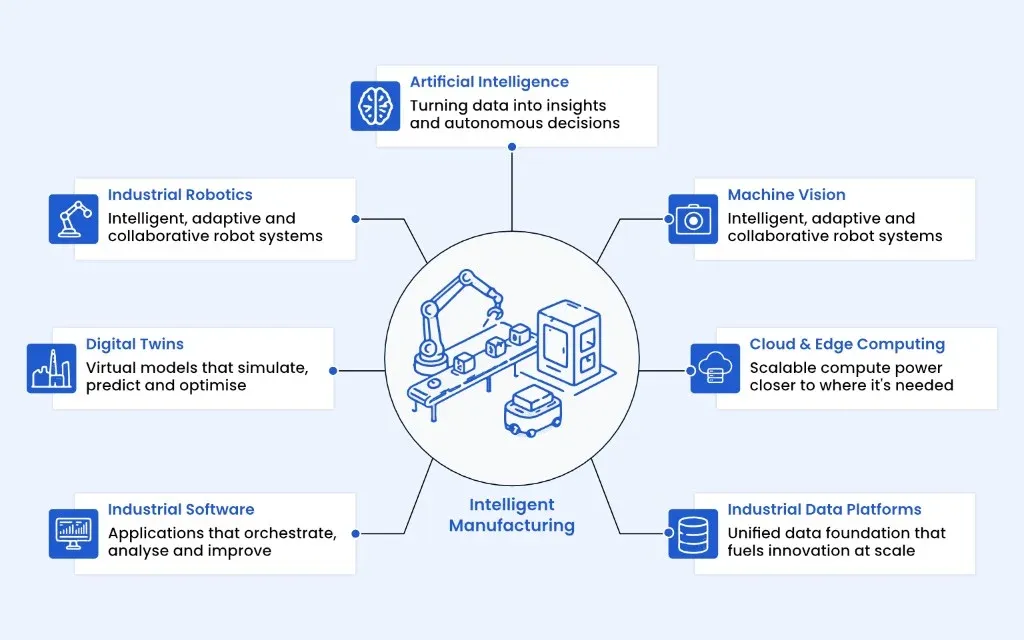
Artificial intelligence, robotics, simulation, digital twins, industrial software and cloud infrastructure are all advancing simultaneously. Manufacturers rarely deploy these technologies independently; they expect them to function as part of a connected production environment. As a result, progress depends less on advancing individual technologies in isolation and more on combining expertise drawn from multiple disciplines.
Few industry players possess deep knowledge across every area shaping intelligent manufacturing. Developing every component internally is often slower and more resource intensive than working alongside specialists whose technologies complement one another.
Partnerships, open interfaces and developer communities have therefore become practical mechanisms for accelerating development. Rather than attempting to own every layer of the technology stack, companies can concentrate on their areas of expertise while benefiting from advances taking place elsewhere across the industry.
Evidence of a broader shift
Recent developments across manufacturing technologies illustrate how this approach is taking shape.
NVIDIA continues to expand Isaac through collaborations with robotics manufacturers including ABB, FANUC, Universal Robots, KUKA and Yaskawa. Instead of entering the industrial robotics market directly, the company is establishing a shared AI and simulation foundation on which robotics manufacturers can develop Physical AI applications.
A similar philosophy underpins Siemens Xcelerator. The platform has grown by incorporating software vendors, technology providers and specialist partners, allowing manufacturers to assemble solutions from multiple contributors rather than relying on a single vendor’s technology stack.
OMRON’s collaboration with Dassault Systèmes brings factory operations together with virtual twin technology, reflecting the closer relationship that is emerging between operational technology and engineering software throughout the manufacturing lifecycle.
Intrinsic’s partnership with FANUC addresses another aspect of industrial automation. By combining software-first development tools with one of the world’s largest installed robot bases, the collaboration seeks to reduce programming complexity and make industrial robotics easier to deploy at scale.
What these developments really indicate
For many years, expanding a product portfolio was one of the primary ways industrial companies strengthened their market position. Today, the ability to connect products with complementary software, engineering tools and partner expertise has become an equally important source of value.
This does not diminish the importance of proprietary technology. Strong products remain the foundation of successful automation platforms. Their value, however, extends further when they can be integrated with complementary software, adopted by developers and supported by a broad implementation network.
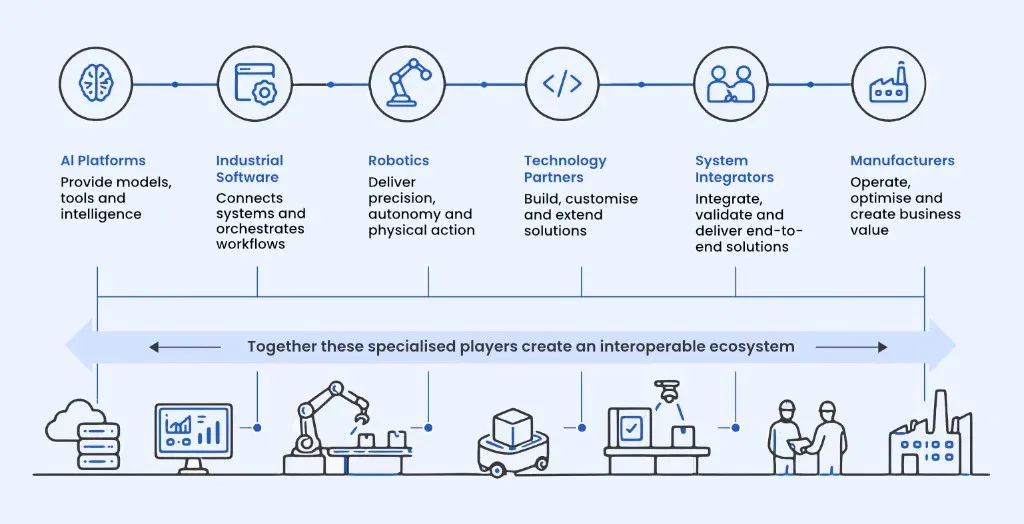
The same principle applies to software platforms. Those that attract developers, system integrators and specialist partners often evolve more rapidly because improvements no longer depend exclusively on internal product teams. New applications, integrations and engineering expertise can emerge from across the wider community, extending the usefulness of the platform over time.
Viewed individually, many of the partnerships announced over the past year appear to address specific technical challenges. Collectively, they reflect a broader transition in how industrial automation is advancing. Rather than attempting to solve every problem independently, companies are creating frameworks that make collaboration between complementary technologies both practical and scalable.
How decision-making is changing
This shift is also influencing how automation strategies are evaluated. While technical performance remains fundamental, several additional considerations are becoming equally important when selecting platforms and planning long-term technology investments.
- Technology evaluation extends beyond hardware performance. Manufacturers are placing greater emphasis on engineering tools, software compatibility, simulation capabilities, AI integration and the availability of implementation partners alongside traditional product specifications.
- Long-term flexibility has become a strategic consideration. Automation platforms are being assessed on their ability to accommodate future software, AI capabilities and production requirements without extensive redesign or vendor replacement.
- Engineering efficiency is becoming a differentiator. Reducing development effort, simplifying system integration and shortening deployment timelines can deliver as much value as incremental improvements in hardware performance.
- Specialisation is becoming more practical. Rather than attempting to develop expertise across every technology domain, companies can focus investment on areas where they create the greatest value while relying on specialist partners to complement those strengths.
- Ecosystem maturity is becoming part of technology selection. The quality of documentation, developer resources, integration support and the surrounding partner network heavily influences how quickly solutions can be implemented, maintained and expanded over time.
These considerations do not replace traditional measures such as performance, reliability or total cost of ownership. Instead, they broaden the evaluation process by recognising that long-term success depends not only on the quality of individual products, but also on how effectively those products fit within an evolving industrial environment.
Looking ahead
The growing emphasis on open ecosystems does not suggest that product innovations have become less important. On the contrary, strong products remain the foundation of every successful industrial platform.
What is changing is the context in which those products create value.
As robotics, AI, simulation and industrial software become more closely connected, competitive differentiation is being shaped by more than individual product performance. The quality of developer tools, software architecture, engineering workflows, implementation expertise and integration capabilities all contribute to how successfully technologies can be adopted and extended over time.
This evolution also raises an important question.
If manufacturers increasingly have access to comparable robotics hardware, AI capabilities and connected digital platforms, where will meaningful differentiation come from?
That question shifts attention beyond the hardware itself. As foundational technologies become more widely available, software is assuming a larger role in determining how effectively those technologies are orchestrated, adapted and scaled to solve real manufacturing challenges.
That is the focus of Part 3 of the Beyond Intelligent Robots series, where we examine why software is emerging as one of the defining layers of competitive advantage in the Physical AI era.