Insurance Claims in the AI Era: Can Faster Decisions Help Tackle Rising Severity?
Synopsis
Faster claims handling has been one of the clearest returns on AI in insurance, and claim costs have continued to climb regardless. This article examines why speed and severity are separate problems, what is genuinely driving settlement costs upward, and why the information beneath a claims decision matters more than the model making it.
The cost of settling an insurance claim has been climbing for years, pushed up by more expensive repairs, higher medical costs, and litigation outcomes that keep growing larger. An accident that settled for one figure a decade ago settles for considerably more today.
Carriers have put real effort into responding, and most of it has gone into speed. AI now assesses damage from photographs, reads and sorts documents, flags unusual claims, and routes files to the right adjuster, so claims that once took weeks to acknowledge are handled in hours.
That is a real improvement, and claim costs have kept rising anyway.
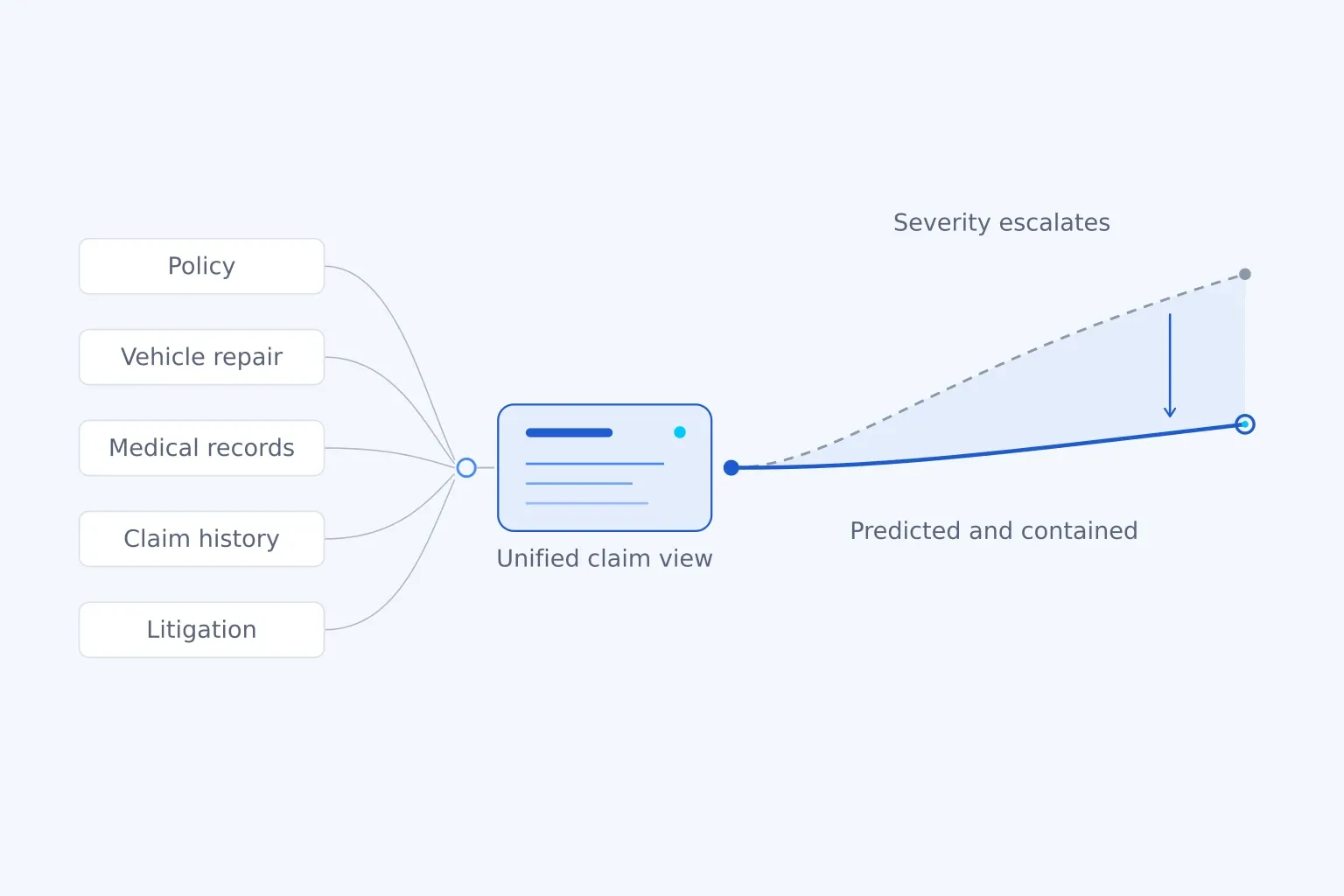
The gap between those two facts is worth sitting with, because it points at something many carriers already suspect. The speed of a claims decision matters considerably less than the quality of the information behind it. In most insurance organizations, that information sits across systems that were never designed to work together.
This article looks at what AI in insurance claims has genuinely fixed, what it has not, and where the difference between the two actually lies.
What claims automation actually fixed
Cycle time was a real problem, and automation has made measurable progress against it.
Faster acknowledgment shortens the window in which a frustrated claimant loses confidence in the process, and that matters for retention as much as for cost. Automated review also surfaces suspicious patterns earlier, which is where a meaningful share of unnecessary payout has always hidden.
These are real gains, and carriers were right to pursue them.
What they do not touch is why a claim becomes expensive in the first place, because most of those reasons sit outside the claims department entirely.
Why claims severity keeps rising
Several forces are pushing claims costs higher, and most are not problems that claims automation can solve directly.
Litigation
Litigation is one of the clearest examples.
Social inflation1, including larger jury awards and settlements2, continues to put pressure on liability claims. The impact is particularly visible in commercial auto and other liability lines, where a claim that initially appears manageable can become considerably more expensive as legal involvement develops3.
The important point for claims organizations is not simply that litigation is becoming more costly. It is that attorney involvement and litigation trajectory can become important severity signals well before final settlement. (Sources: 1, 2, 3)
Physical complexity
The insured asset itself is also changing.
A modern vehicle carries cameras, radar, sensors, and other electronic systems alongside traditional mechanical components. A relatively minor collision can therefore involve specialized parts, calibration, diagnostics, and longer repair cycles.
The result is a claims environment where the visible damage does not always tell the full story of the eventual cost.
USI attributes the doubling of average loss severity for commercial auto liability claims since 2015 to exactly this combination of repair technology and litigation pressure.
Concentration of loss
Property claims show a similar pattern: fewer claims do not necessarily mean lower claims costs.
When losses become more concentrated, the claims that do occur can carry substantially higher severity. For carriers, this makes early identification of potentially expensive claims more important than simply improving the average processing time across the entire book.
LexisNexis found that claims severity across all perils reached a seven-year high in 2025, up 93.2% against 2019, even as claim frequency fell 23.8% year over year.
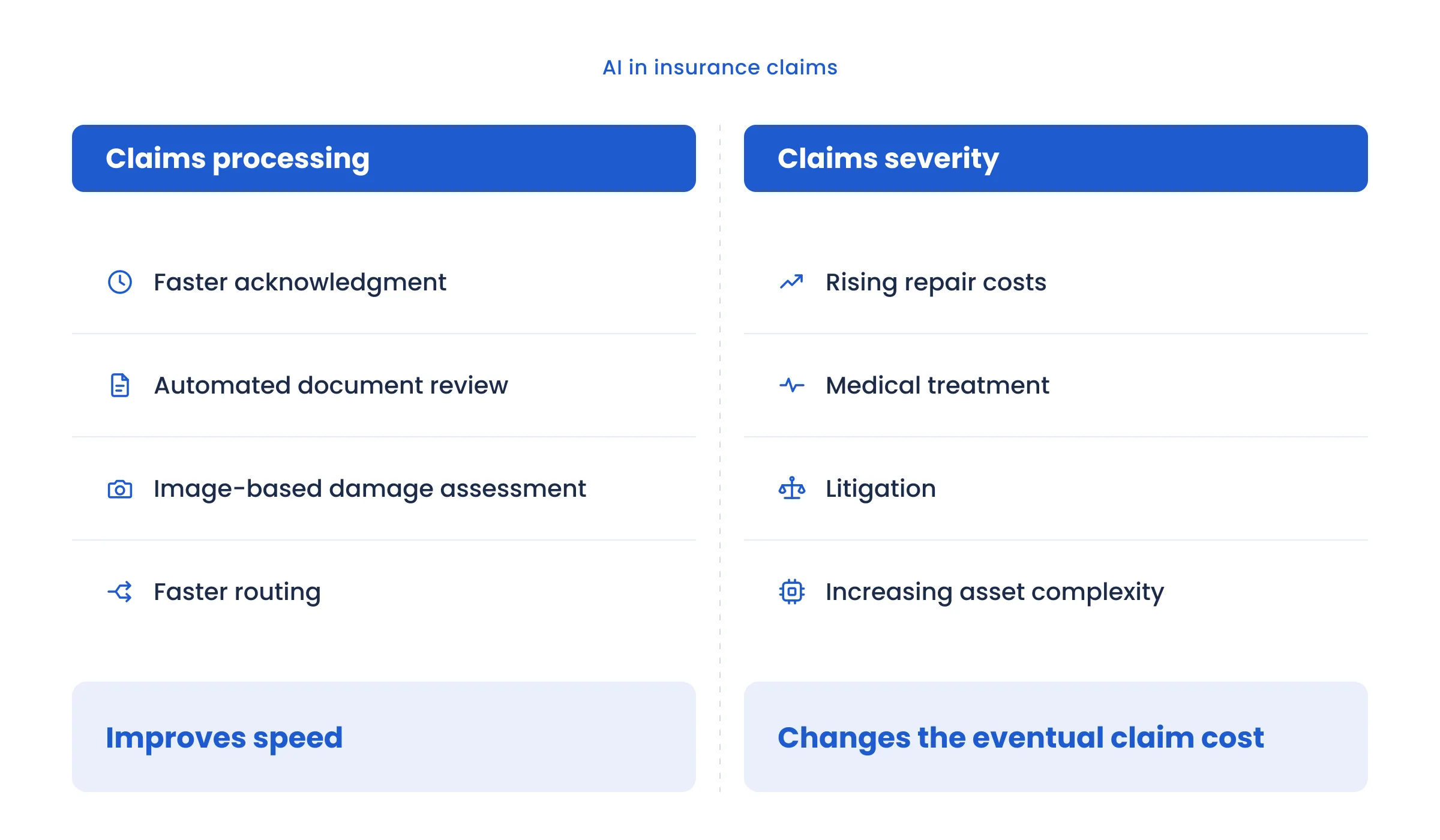
Automation does not directly reverse any of these forces.
It can make the claims organization more efficient while the underlying economics of each claim continue to worsen.
That distinction is important. Efficiency improves the process. Severity requires better decisions.
Where AI can genuinely help
The claims that ultimately become expensive do not always look expensive when they are first reported.
A claim may begin as an ordinary file and change over time: an attorney becomes involved, treatment continues, repair complexity increases, or new information changes the expected settlement.
The opportunity for AI is therefore not limited to processing the claim faster.
It is to identify which claims are changing in ways that warrant attention.
That is a prediction problem rather than a processing problem.
AI can help identify patterns associated with increasing severity, prioritize claims for additional review, and surface signals that might otherwise remain buried in a large claims inventory.
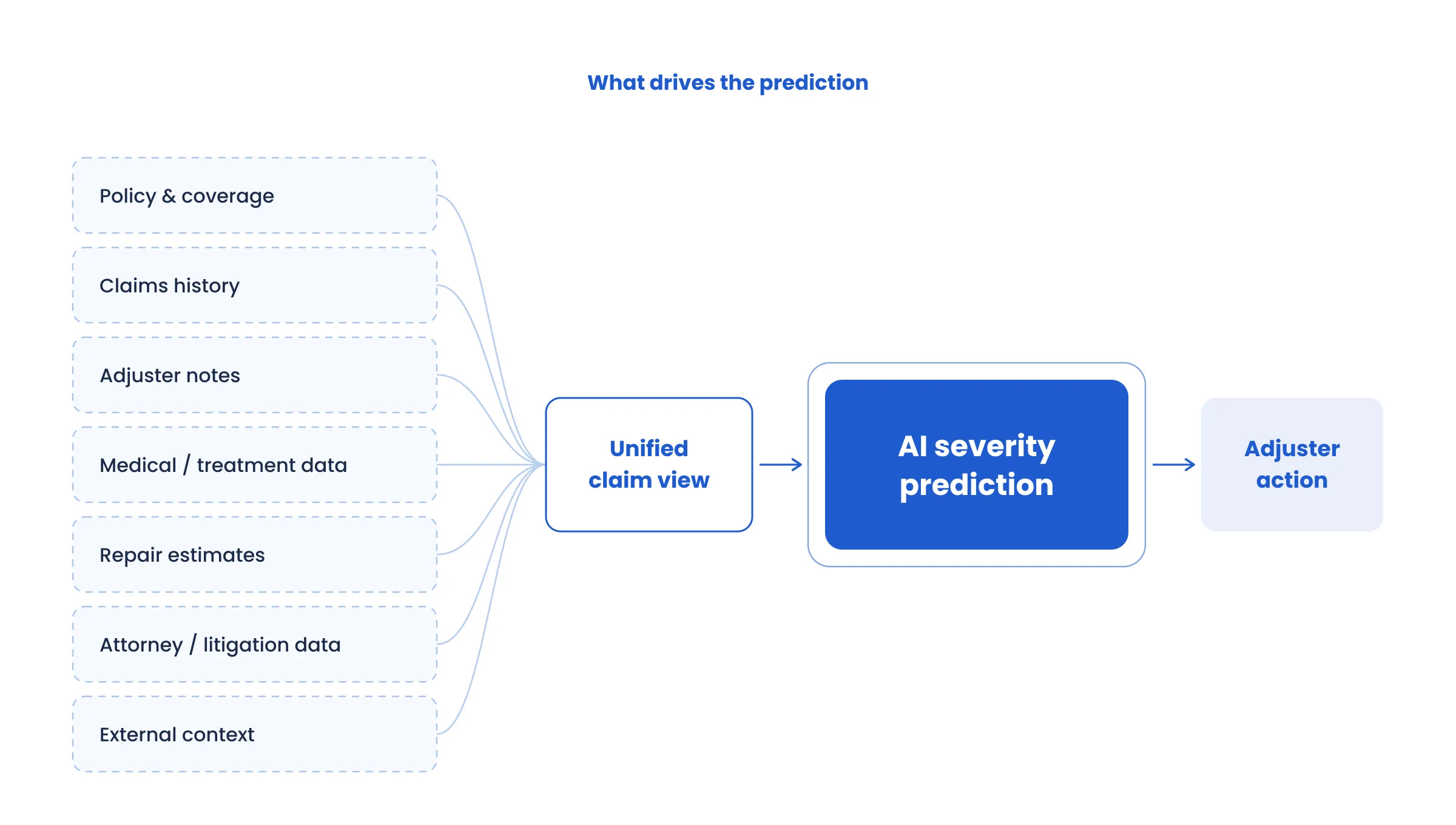
But prediction quality depends on what the model can actually see.
For many carriers, that is the harder engineering problem.
A complete view of a claim rarely exists in one place.
Signals may sit across the claims platform, policy administration system, adjuster notes, medical records, repair estimates, prior loss history, and external litigation data.
The information may use different structures, update at different times, and be owned by different teams.
The model may be sophisticated.
The data it receives may still be incomplete.
That creates a familiar gap between a successful AI pilot and a useful production system.
A model can perform well on a clean historical dataset and still struggle when the live environment contains missing information, delayed updates, inconsistent records, and new patterns not represented in training.
The constraint is often not the model.
What carriers need to get right
None of this is an argument against AI in insurance claims, but rather for treating the data and systems underneath the model as part of the AI program itself.
A few questions tend to determine whether a claims AI initiative can move beyond a promising pilot.
Start with the claim record, not the model.
Before predicting what happens next, the organization needs a reliable picture of what is happening now.
That means identifying where the relevant information lives, how it is updated, and how the different versions of a claim are reconciled.
Check whether the signals you would act on are captured at all.
Some of the most useful signals may not exist as structured data.
Attorney involvement, treatment patterns, repair complexity, and other contextual details can sit inside adjuster notes, documents, correspondence, or attachments. If those signals cannot be reliably extracted and connected to the rest of the claim, an AI system cannot make use of them.
Bring in the data that sits outside the claim.
A claim also needs context.
Policy history, prior losses, customer information, and external litigation data can materially change how the same claim should be interpreted. Bringing those signals together is often an integration problem before it becomes an AI problem.
Test on real conditions, not clean samples.
A model should be evaluated against the conditions in which it will actually operate: incomplete records, delayed updates, changing claim patterns, and the volume and variability of production data.
A strong result on a prepared dataset is useful but doesn’t guarantee production readiness.
Make sure someone can act on what the system finds.
An early warning only creates value if someone can act on it.
If an AI system identifies a potentially severe claim but the adjuster has no additional information, no defined workflow, or no capacity to intervene, the prediction adds another signal without changing the outcome.
The technology and the operating process therefore need to be designed together.
This is also where claims modernization becomes an engineering problem.
At Infocusp, our insurance work has included the software and cloud infrastructure behind policy issuance, renewals, and real-time claims management across multiple states. The work has required connecting business-critical workflows with the systems and data underneath them, where reliability and integration determine whether a solution works beyond the demonstration.
The visible AI capability is only one layer.
The more consequential work is often making sure the information reaching that capability is complete, current, and usable.
That is often the difference between an AI capability that looks promising in a pilot and one that becomes part of the claims operation.
Looking ahead
Insurance claims severity is unlikely to decline simply because claims processing becomes faster.
The forces driving severity sit largely outside the claims workflow. What carriers can influence is how early they recognize a claim that is changing, how confidently they understand the reasons, and how quickly the organization can respond.
That capability does not arrive with a model. It arrives when the systems holding a claim’s history can provide a coherent, timely picture of what is happening accurately and quickly to whatever is making the decision.
The industry has made substantial progress on claim speed.
The next challenge is different: using the information already present across the claims ecosystem to identify risk earlier and make better decisions about where attention is needed.
AI can help with that.
But the quality of the decision will depend on the quality of the system beneath it.
If your organization is working through claims or policy modernization and would value a conversation about the engineering underneath it, our insurance tech team would be glad to talk.