
Engineering intelligent sleep technology from sensor to cloud
A wellness-focused sleep technology company developed a smart mattress with embedded sensors designed to understand sleep and physiological patterns without direct contact. We engineered the underlying sensing, embedded systems, AI, and cloud infrastructure required to deliver personalized sleep insights and adaptive comfort.
About the client
A sleep technology company developing a smart mattress designed to help people understand and improve their sleep through embedded sensing and intelligent technology.
The product used sensors embedded beneath the mattress surface to capture physiological signals without requiring direct contact with the user. The resulting data needed to be processed into meaningful sleep metrics while also supporting personalized adjustments to the sleeping environment.
The engagement covered the technology stack required to make this possible—from sensor and firmware integration to AI models, cloud infrastructure, and mobile application connectivity.
The business challenge
Smart sleep technology requires accurate physiological sensing in an environment where sensors cannot directly contact the user. Signals captured through mattress materials can be subtle and affected by movement, sleeping position, and other environmental factors.
The client needed to reliably extract physiological and sleep-related information from these signals while maintaining a secure and scalable system for storing and analysing data over time.
The product also needed to move beyond measurement. Sleep data had to support personalized insights and adaptive comfort, creating an experience that could respond to individual sleep patterns and evolve with continued use.
Key Challenges
- Capturing physiological signals accurately through non-contact sensors embedded beneath foam.
- Extracting high-fidelity sleep and physiological metrics from complex sensor signals.
- Supporting different hardware and sensor configurations across product generations.
- Converting physiological data into useful, individualized sleep insights.
- Enabling real-time adjustments to improve user comfort.
- Securely storing and processing sensitive sleep and physiological data.
How we solved it
We engineered the technology foundation for the smart bed across embedded sensing, signal processing, AI, and cloud infrastructure.
At the device level, we developed and integrated sensing firmware across multiple hardware generations, enabling the product to collect physiological signals consistently as its hardware evolved.
We then developed AI models capable of analysing these signals to identify sleep stages and other relevant patterns. The models also supported adaptive comfort adjustments, allowing the smart bed to respond to individual sleep behaviour in real time.
At the platform layer, we built secure and scalable cloud infrastructure and data pipelines for storing, processing, and accessing sleep data. This created the foundation for personalized insights and integration with the broader mobile application experience.
Solution Highlights
- Integrated embedded sensors and custom firmware across multiple hardware generations.
- Developed signal-processing capabilities for non-contact physiological sensing.
- Built AI models for sleep-stage tracking and physiological analysis.
- Enabled adaptive comfort adjustments based on individual sleep patterns.
- Created secure cloud infrastructure for sleep data storage and processing.
- Developed scalable data pipelines for continuous sleep data analysis.
- Supported integration between embedded systems, cloud services, and mobile applications.
Business outcomes
Business Impact
-
The resulting technology ecosystem enabled the smart bed to move beyond passive sleep tracking toward a more adaptive and personalized sleep experience.
-
The combination of embedded sensing, AI, and cloud infrastructure allowed the product to interpret individual sleep patterns and use those insights to provide personalized information and real-time comfort adjustments.
-
The engagement also evolved into a long-term technology partnership spanning more than eight years, supporting continued innovation across multiple product lines and hardware generations.
How might this challenge look in your industry?
Although this engagement focused on smart sleep technology, the underlying challenges of extracting meaningful intelligence from non-contact sensors, processing physiological signals, and connecting embedded products to AI and cloud systems apply across many connected-product environments.
- Healthcare
- Capturing physiological signals through connected medical devices and using AI to support monitoring, analysis, and personalized care.
- Fitness & Wellness
- Combining wearable or environmental sensor data with AI to understand activity, recovery, sleep, and other personal health metrics.
- Automotive
- Using non-contact sensing and AI to monitor drivers, passengers, vehicle conditions, and other real-time signals.
- Consumer Electronics
- Building connected products that combine embedded sensors, intelligent algorithms, cloud services, and personalized experiences.
- Industrial IoT
- Processing sensor signals from equipment and environments to identify conditions, predict events, and support automated responses.
- Manufacturing
- Using embedded sensors and AI to monitor machinery, production environments, and equipment behaviour.
- Smart Buildings
- Combining environmental and occupancy sensors with intelligent systems to optimize comfort, energy consumption, and building operations.
- Sports Technology
- Processing physiological and performance signals to provide athletes and users with personalized insights and recommendations.
Related case studies
-
Healthcare
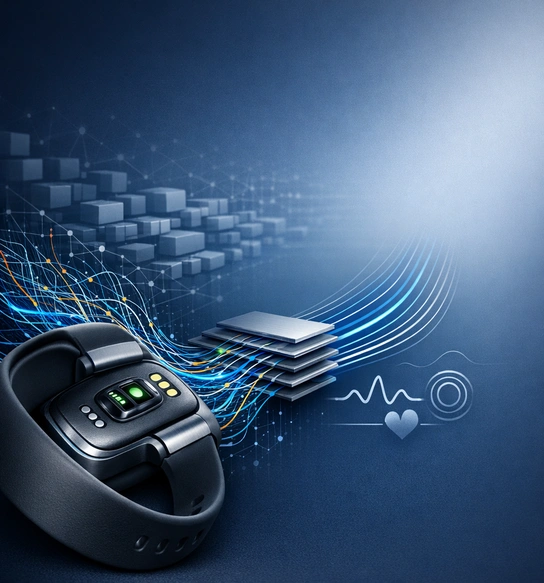
Engineering wearable technology across product generations
A series of health-focused wearable devices aimed to estimate sleep, vital signs, and other physiological metrics to help users better understand their health and lifestyle. We supported the evolution of these products across multiple generations, delivering technology across firmware, AI, cloud infrastructure, and mobile applications.
Solution areas
- IoT
- Firmware Engineering
- Platform Engineering
- Artificial Intelligence
-
Wearable Tech
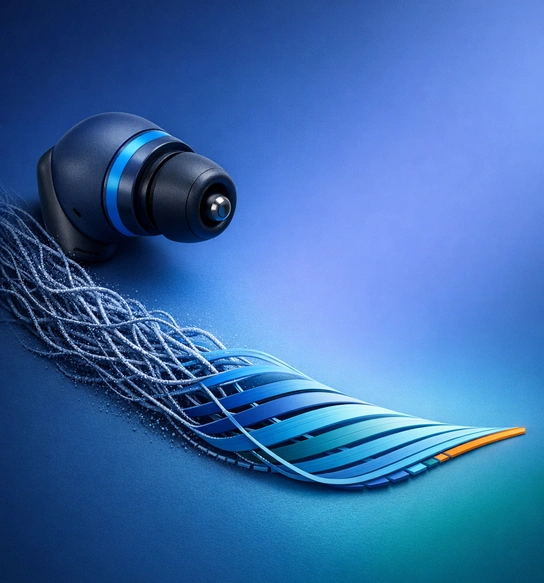
Integrating real-time brain sensing into a compact wearable
A wearable technology company developed compact in-ear devices with integrated EEG sensing to capture brain signals in real time. We engineered the signal processing, embedded AI, and low-latency systems required to turn complex physiological signals into reliable, responsive brain-sensing capabilities within a highly constrained wearable form factor.
Solution areas
- Signal Processing
- Embedded AI
- Real-Time Systems
- Wearable Technology

Facing a similar connected product or AI challenge?
Whether you're developing a sensor-enabled product, working with physiological or environmental signals, or building AI capabilities across embedded and cloud systems, we can help you engineer the technology stack required to turn complex sensor data into intelligent, personalized experiences.
Talk to Our Experts