- mobile-development
- software-architecture
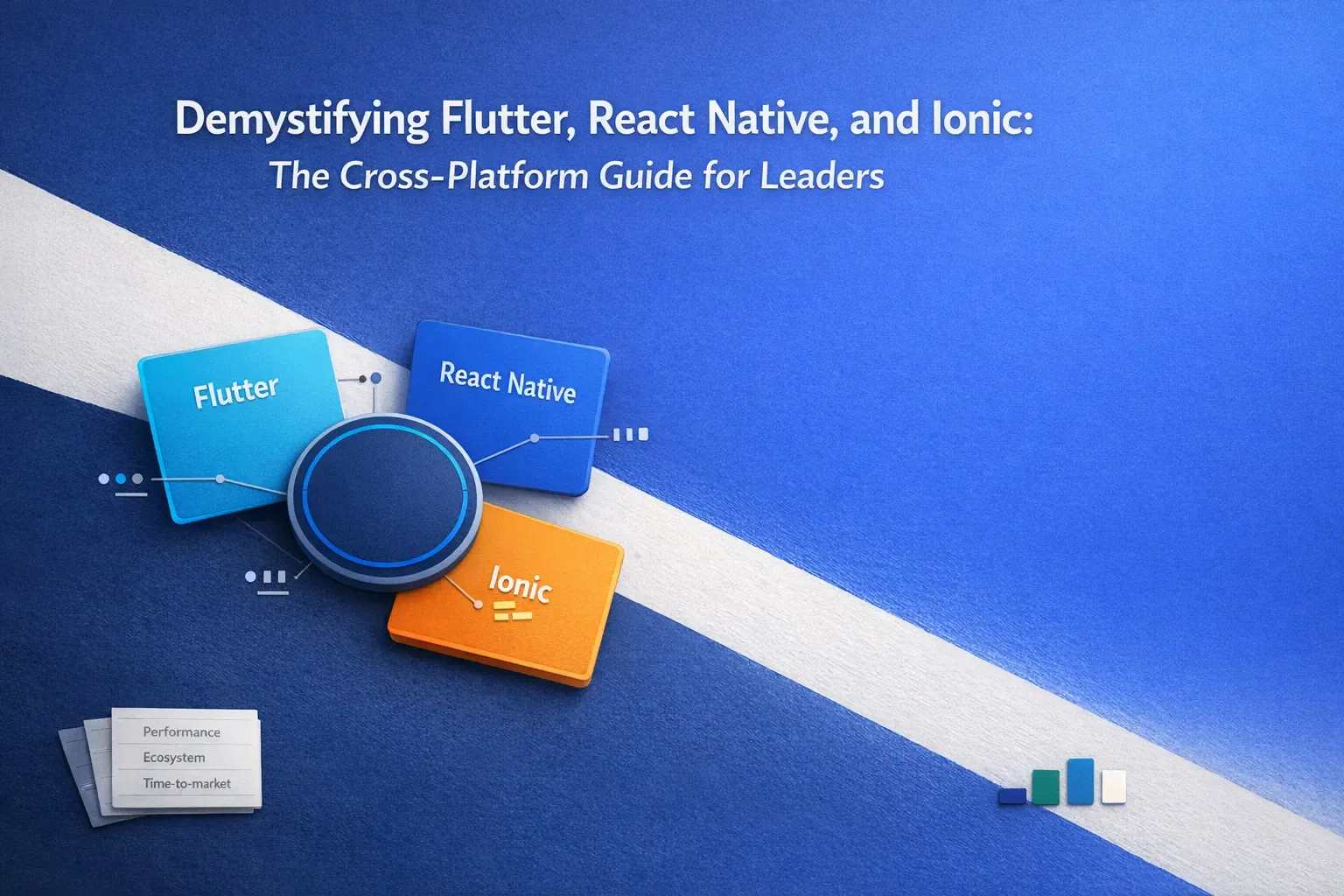
Demystifying Flutter, React Native, and Ionic: The Cross-Platform Guide for Leaders

Introduction
The mobile development world is evolving fast. Not long ago, building separate native apps for iOS and Android was the standard. Today, cross-platform frameworks have reshaped that landscape with Flutter, React Native and Ionic becoming widely adopted across the industry.
For engineering leaders, this isn’t just a coding choice – it’s a strategic decision that defines your team’s efficiency, hiring plans, and how quickly you can deliver features a year from now. The right choice can set your product up for years of smooth growth, while the wrong one can quietly introduce friction into every release.
This guide isn’t about declaring a winner. It’s about understanding the real trade-offs – performance, scalability, ecosystem, and long-term maintainability – so you can choose what fits your product and your organization best.
The Strategic Context: Why This Decision Matters
The stakes have never been higher in choosing a mobile framework. One decision now shapes your development costs, delivery speed, team scalability, and long-term maintainability.
- Development costs: up to 40–50% lower compared to native builds.
- Time-to-market: 3–4 months faster on average.
- Talent scalability: as much as a 6× difference in available developer pool between frameworks.
- Maintenance: 20% cost variance over a two-year horizon.
- Enterprise readiness: only select frameworks provide official support and SLAs.
Gone are the days when native development was the clear winner. Data from 2024–2025 shows that modern cross-platform frameworks can deliver near-native performance while offering dramatic gains in speed and efficiency.
The real question isn’t whether to go cross-platform – it’s which framework best aligns with your business goals, team strengths, and growth strategy.
Flutter, React Native, and Ionic: What you need to know
While cross-platform frameworks have matured, 2025 presents quite a changed landscape from just a few short years ago. In their own ways, Flutter, React Native, and Ionic have carved out their niches-from rich UIs to web-first apps-but before you commit your team and budget to any one of these, it is critical that you understand the relative strengths and trade-offs of each of these major frameworks.
1. Language & Stability: Dart vs. JavaScript
Flutter uses Dart, a strongly typed, client-optimized language with null safety built in. For larger projects, this means fewer runtime surprises, easier refactoring, and more robust code. In other words, Dart helps teams catch errors early and build maintainable apps without relying on extra tooling.
React Native relies on JavaScript, or optionally TypeScript. JavaScript’s ubiquity makes hiring easier and the ecosystem massive, but its flexibility can introduce subtle bugs unless you enforce strict type safety through TypeScript. For teams prioritizing long-term stability and maintainability, Dart often gives Flutter a small edge.
Ionic, being a web-first framework, relies on HTML, CSS, and JavaScript. It’s approachable for web developers but can add complexity when implementing native-level features or performance optimizations.
2. Rendering & Performance
Flutter’s standout feature is its own rendering engine, currently moving from Skia to Impeller. This gives developers complete control over every pixel, resulting in consistent, smooth UI performance across platforms, including Android, iOS, and desktop. For apps that demand custom animations, complex UIs, or high visual fidelity, Flutter often delivers the most predictable results.
React Native uses native UI components and communicates through a JavaScript bridge, which can introduce overhead in complex apps. With the new JSI, Fabric renderer, and optional Skia integration, performance has improved significantly. For a deeper look at how React Native’s new architecture works under the hood, explore the official documentation here.
Ionic renders through WebView, making it excellent for rapid prototyping and web-first apps, but less ideal for graphics-intensive mobile experiences.
3. Ecosystem & Adoption
Flutter remains a powerful and broadly adopted cross-platform framework – trusted by companies like Alibaba, BMW, and eBay. While Google has realigned some internal teams, Flutter continues to receive active investment — with ongoing work on Impeller, performance upgrades, and improved tooling. Google’s recent announcements reinforce this, positioning Flutter firmly in its long-term ecosystem alongside Kotlin Multiplatform, not as a replacement.
React Native continues to thrive, particularly among teams with strong JavaScript backgrounds. Backed and developed by Meta, it benefits from a mature ecosystem and an extensive community – making it a reliable choice for teams looking to leverage existing web expertise.
Ionic has a smaller but dedicated following, especially in projects that prioritize rapid development, cross-platform web reach, and PWAs.
4. Developer Experience: Mobile-First vs. Web-First
Flutter encourages a mobile-first mindset. Its widget-based approach and reactive programming model allow teams to think in terms of mobile UI and state management from the ground up, rather than adapting web paradigms.
React Native will feel familiar to web developers who already know JavaScript and React. It’s a great bridge for teams looking to leverage existing web skills, but sometimes that familiarity comes at the cost of thinking like a native mobile developer.
Ionic, built on web technologies, is the fastest way for web-centric teams to ship cross-platform apps, but it may feel constrained when building truly native experiences.
Performance Analysis: Benchmarks and Real-World Scenarios
Performance isn’t just about smooth animations or faster load times — it’s about how reliably your app scales under real usage, how predictable builds remain over time, and how efficiently your teams can deliver features without hitting invisible technical ceilings.
Let’s look at how Flutter, React Native, and Ionic perform in real-world conditions and why those differences matter.
1. Startup Time & UI Responsiveness
-
Flutter: With its compiled Dart code and custom rendering engine, Flutter delivers near-native startup times. Apps launch quickly, and frame rates consistently hover around 60–120 FPS depending on device capability. Because it draws every pixel directly, UI responsiveness is predictable and consistent across Android and iOS.
-
React Native: Startup performance has improved significantly under the new architecture (Fabric & TurboModules), but it can still lag slightly behind Flutter when initializing the JS runtime bridge. For most consumer apps, the difference is minor, though high-performance UIs (like games or real-time dashboards) might show subtle frame delays.
-
Ionic: Startup time depends heavily on the WebView engine and bundling. Modern devices handle it well, but older phones can exhibit delayed startup (300–600ms longer) and occasional frame drops during complex animations.
2. Memory & Runtime Efficiency
-
Flutter: Memory usage is highly optimized since Flutter controls rendering, layout, and widgets in one consistent pipeline. Apps tend to consume 10–15% less RAM than React Native equivalents in performance tests when UI complexity increases.
-
React Native: Because it relies on the JavaScript bridge for communication with native modules, memory overhead increases with app complexity. Facebook’s newer architecture reduces this gap, but heavy animation layers can still stress memory management.
-
Ionic: Runs inside a WebView and depends on the browser’s memory model. While modern WebViews are efficient, memory fragmentation and garbage collection pauses can appear in long sessions or on low-end devices.
3. Battery & Rendering Load
Flutter’s Impeller engine (successor to Skia) is a game-changer. By compiling shaders at build time, it minimizes runtime GPU spikes and reduces battery drain by up to 20–25% in animation-heavy apps.
React Native, using native components, distributes rendering work efficiently but depends on JavaScript’s event loop, which can occasionally introduce micro-stutters under heavy load.
Ionic’s performance is tied to browser rendering; it’s efficient for lightweight UI and form-based apps but can draw more power during continuous animations or background rendering.
Native Integration and Platform Features
Building for mobile isn’t just about getting apps to run on both iOS and Android – it’s about how deeply your framework connects with each platform. From push notifications and background tasks to gestures and animations, native integration defines how polished your app feels.
Flutter leads this category with its direct rendering engine (Skia) and a robust plugin ecosystem backed by Google. The platform_channels architecture allows developers to bridge seamlessly to native Swift, Kotlin, or Objective-C code when needed. Flutter’s growing library of Federated Plugins ensures better long-term maintainability, as individual platform implementations can evolve independently.
React Native, on the other hand, takes a more JavaScript-driven approach. Its strength lies in flexibility — teams can mix native views and React Native components effortlessly. However, bridging between JavaScript and native layers introduces overhead in some cases. The recent New Architecture (Fabric + TurboModules) improves performance and tightens integration, bringing React Native much closer to native parity than before.
Ionic, powered by Capacitor, bridges web apps to native platforms using a WebView. It’s fast to build with and perfect if your team already lives in the web world, though it can feel less “native” in high-performance use cases.
Community Support and Ecosystem Maturity
When choosing a mobile framework, you’re not just adopting technology – you’re joining an ecosystem. The size, stability, and engagement of that ecosystem directly influence developer productivity, support lifecycles, and the pace of innovation.
React Native benefits from nearly a decade of maturity. Backed by Meta and sustained by one of the largest developer communities in the world, it offers deep library support, proven design patterns, and a wealth of shared knowledge. For enterprises, this translates to lower onboarding friction and faster access to talent.
Flutter’s ecosystem has transitioned from rapid hypergrowth to a more steady, mature phase. While Google’s broader focus on Kotlin Multiplatform has slowed Flutter’s release cadence, the framework remains actively maintained with ongoing work on performance, stability, and tooling. Overall, Flutter remains a stable, well-supported choice, even if its momentum is no longer as explosive as in earlier years.
Ionic continues to hold ground among web-first teams. Its ecosystem, anchored around Capacitor, appeals to organizations with existing JavaScript talent and a need for quick deployment cycles. However, its community momentum is comparatively slower, particularly for high-performance mobile use cases.
According to the 2024 Stack Overflow Developer Survey, ~62% of developers reported using JavaScript, while only ~6% reported using Dart. This illustrates why it’s generally easier to find React Native or Ionic developers – there’s a much larger JavaScript talent pool – compared to Flutter developers, who need specific Dart expertise.
Real-world Case Studies
The real story starts after the decision. Here’s how some of the world’s top engineering teams turned their framework choices into measurable results.
Google Pay
Google re-architected its flagship payment app to run across iOS and Android on one codebase using Flutter. Within six months a 50-engineer team launched a beta in Singapore; the full-scale rollout followed with over 100 million monthly users.
Key migration lessons:
- They reduced the codebase from 1.7 million lines to 1.1 million – a 35% drop – simplifying maintenance and lowering bug risk.
- The shift allowed global market launches without having to maintain separate Android/iOS stacks.
- Flutter’s plugin ecosystem (including Google-supported payment plugins) enabled integration with payments, security, and platform-specific APIs effectively.
Behind the Tech:
- Choosing a strongly typed language (Dart) and full rendering engine (Skia → Impeller) meant Google could guarantee UI parity and performance across platforms.
- Even a large-scale org found that with Flutter they could focus on feature delivery rather than platform divergence.
- For teams with global scale, the benefit came from unified tooling, fewer divergent code paths, and streamlined CI/CD.
Shopify
Shopify chose React Native to unify its iOS, Android and web development efforts. Their flagship mobile app (300 + screens) began a phased migration rather than a full rewrite.
Key migration lessons:
- They introduced React Native incrementally through a program called “RN Accelerator” to train engineers from Kotlin/Swift to JS/TS, React and RN.
- A migration prioritization based on reach, impact, confidence and effort (RICE model) allowed them to pick which features to port first and track progress via dashboards.
- Rather than a full rewrite, they migrated in parallel: new features built in RN; legacy screens ported gradually. This minimized disruption to business feature delivery.
Behind the Tech:
- Because Shopify already had large web/JavaScript talent, React Native leveraged existing skills and accelerated team ramp-up.
- The framework’s ecosystem support (libraries, tooling) helped unlock reuse and lowered hiring barriers.
- They maintained weekly shipping cadence throughout migration, proving that large scale moves are possible without sacrificing velocity.
Sworkit
Sworkit, a fitness app, rebuilt using Ionic to cut costs, launch faster and reuse its web team’s skills.
Key migration lessons:
- The rebuild took just ten weeks initially. For a lean team, that speed was critical.
- Because the team used web technologies (HTML, CSS, JS) they didn’t have to hire mobile-native specialists; they leveraged existing talent.
- By sharing one codebase for web + mobile, they saved over $200,000/year in developer cost and cut time to market in half.
Behind the Tech:
- Ionic’s WebView-based rendering is ideal when app demands are moderate (forms, content, simple animations) rather than heavy graphics or custom UI.
- The code reuse across platforms means internal tools, marketing apps or MVPs become faster and cheaper to deliver.
- For enterprises with large web teams and less mobile specialization, it reduces onboarding and cost risk.
Decision Framework: Choosing what fits your strategy
Selecting the right framework isn’t about trends – it’s about alignment. Your decision should balance speed, scalability, and sustainability.
🧭 Strategic Fit
- Long-Term Stability & Performance? → Flutter (predictable UI, native-like speed).
- Enterprise Support Needed? → Flutter (backed by Google, strong roadmap).
- Time-to-Market Priority? → React Native or Ionic (faster iterations, wider talent pool).
👥 Team & Ecosystem Fit
- Mobile-First Team (UI/UX precision)? → Flutter (single codebase, consistent rendering).
- Plugin Ecosystem & Community? → React Native leads in libraries and tooling.
- Web-Heavy Team (JS/TS)? → React Native or Ionic (lower learning curve).
⚙️ Technical Fit
| Criteria | Flutter | React Native | Ionic |
|---|---|---|---|
| Performance | ★★★★★ | ★★★★☆ | ★★★☆☆ |
| UI Consistency | ★★★★★ | ★★★★☆ | ★★★☆☆ |
| Web/Desktop Support | ★★★★☆ | ★★★☆☆ | ★★★☆☆ |
| Talent Availability | ★★★★☆ | ★★★★★ | ★★★★☆ |
Takeaways
The cross-platform debate isn’t really about technology anymore – it’s about fit. Each framework has matured to a point where the trade-offs are less about capability and more about alignment with your team’s goals and structure. At the leadership level, the right choice comes down to what you’re optimizing for: velocity, performance, or versatility.
Flutter shines when you need tight control over UI and long-term consistency across platforms.
React Native thrives when speed, flexibility, and access to a massive JS ecosystem matter most.
Ionic still delivers strong value for web-centric teams and rapid prototyping cycles.
Success depends on matching framework strengths to organizational realities, not pursuing theoretical optimization. The mobile development landscape continues evolving rapidly, but the fundamental trade-offs between performance, talent availability, and enterprise support remain constant.